Who is this flipbook for and how might it be used?


This flipbook is for Teacher Educators (TEs), school leaders, and other stakeholders who are interested in implementing Lesson Study in Initial Teacher Education (LS in ITE). We assume that, although your roles may differ, you share a common interest: improving Pre-Service Teachers’ (PSTs’) learning through LS.


The main goal of this flipbook is to offer both a general orientation and practical suggestions for carrying out LS in ITE contexts.


The ideas in this flipbook may feel familiar or be new. They may be familiar if you have previously engaged in LS in other settings (for example, in a professional development context) or if you have experience with action research or communities of inquiry, which share some similarities with LS. LS may also be entirely new to you. We therefore expect that some readers will use this flipbook as an introduction to LS.


As readers will come with different levels of experience, the flipbook is designed to be used both linearly and non-linearly. You may move freely between chapters, depending on the topics you wish to explore in more depth. However, if you are new to LS, we recommend starting with the first and second chapters, which introduce the core ideas and provide a foundation for reading the chapters that follow.


Throughout the flipbook, you will find internal and external links that make it easy to access related content. You will also find a set of guiding questions that you can use whenever you are ready to select the LS variant that best fits your context. These guiding questions are accessible by clicking the decision tree button.


Decision Tree 


Finally, the flipbook includes case studies that illustrate how LS can be adapted to different ITE contexts and subjects. We also encourage you to explore the resources attached to this flipbook, which you can download and use directly with PSTs.

Page 3

1. Introduction


1.1 What is the goal of this flipbook?


This document is part of the Lesson Study in Future Teacher Education (LIFT) project’s resource suite designed to support the implementation of Lesson Study (LS) within Initial Teacher Education (ITE). It aims to assist stakeholders across ITE programmes in shaping and enacting this process.


At its core, LS is a practice-based process where Pre-Service Teachers (PSTs), Teacher Educators (TEs) or mentors collaboratively plan, conduct, and reflect on a research lesson designed to address a specific issue about student learning. This involves in-depth preparation: studying the curriculum and research, designing detailed lesson plans with anticipated student responses, and enacting and observing the lesson. Structured reflection follows, based on evidence of student learning, with the goal of improving both understanding of the teaching issue and participants’ learning.


In ITE, LS not only enhances pedagogical and educational knowledge, but also develops PSTs’ collaborative, reflective, and inquiry skills. It can address broader priorities such as inquiry-based learning, inclusive practices, or technology use. Given the constraints of ITE, the LS process can be adapted to various contexts, like practicum settings or coursework. This flipbook is designed to provide assistance when adapting LS to different contexts, while respecting its fundamental elements.

LIFT Project Members
Page 4

Read more on:

What is the purpose of the flipbook?

This document is intended to guide Teacher Educators (TEs) and Pre-Service Teachers (PSTs) in incorporating Lesson Study (LS) into Initial Teacher Education (ITE). In a context of teacher shortages across Europe, strengthening ITE quality in a sustainable way is critical: LS provides a collaborative framework that allows PSTs to grow professionally, develop their sense of self-efficacy and adapt their practice to focus on student learning.


The Lesson Study in Future Teacher Education (LIFT) project builds on experimented LS models to empower PSTs through meaningful partnerships, offering different resources to promote high-quality ITE.


The purpose of this flipbook is to support TEs in using LS in ITE programs for all school levels. It is addressed to TEs at teacher education institutions and to school-based mentors or cooperating teachers who collaborate with ITE. It will also be of interest to PSTs participating in lesson studies.


Learn more about the LIFT project from the project leader, Sui Lin Goei:

What is lesson study?

LS is a practice-based teacher education approach in which a group of participants – in ITE, PSTs and TEs – work together in preparing, enacting and reflecting on a lesson.


The activity begins with the LS group identifying a research question, often based on a common learning challenge observed among school students. The group then collaboratively formulates the aim of the lesson in relation to this question, using it to guide planning and reflection throughout the LS cycle. Then, the activity proceeds by carrying out a study of curriculum materials, professional and research papers and other documents that address such difficulty and perhaps making a close diagnostic of students’ knowledge and difficulties. Then, based on this, the participants do a detailed planning of a lesson. This lesson, called the research lesson, is enacted by a member of the group and observed by the remaining members. Finally, considering the aims of the lesson, the group reflects on the observed students’ learning and provides suggestions for improvement in the lesson plan and in the way the lesson was enacted.


This process typically spans six to eight working sessions, including the research lesson, and may require approximately 12 hours of collaborative work.


What is a lesson study, according to Stéphane Clivaz, a project member and the president of the World Association of Lesson Studies:

Why use lesson study in initial teacher education?

Lesson study as a system of learning

The LS process can be considered in a systemic way, as it creates a community of learning with different interrelated layers. The school students are learning during the research lesson, and they should know that the goal of the observation is to improve teaching and their learning so that they feel part of the community of learning.


Professional learning for teachers

The preservice or in-service teachers participating in the LS acquire professional knowledge about the effects of their teaching on students’ learning.

Literature in this field shows that this learning may take various forms:

  • better linking theory and practice
  • adopting a reflective and inquiry stance
  • developing collaborative skills
  • fostering teacher noticing
  • focusing on pupils and learning rather than on teaching
  • developing an attitude to anticipate pupils’ reasoning
  • deepening subject-matter knowledge and pedagogical content knowledge
  • improving teaching skills such as precise language use and time management


Impact on the education system

The process also helps TEs, researchers, textbook authors, and school administrators inquire into their own practice.


Moreover, joint participation in the process, even if it is only in an open research lesson and the discussion surrounding it, strengthens connections between the different parts of the education system.

What are the different ways to conduct lesson study in initial teacher education?

LS in ITE may be conducted in a variety of ways and with different PST groups. When PSTs are in their practicum, they may be working in isolation, in pairs, or small groups.


Sometimes, it is possible to join PSTs working individually or in pairs in a small group of three or four. A small group with three or four PSTs preparing a common research lesson is a very good organisation to carry out LS, but this may be adapted to other arrangements LS can also be used within existing courses (methods or didactics, for instance), giving the TEs as well as the students a new window to look at their professional thinking and pupils’ learning.


In that situation, depending on the number of students, one or more research lessons could be prepared and discussed. Adaptations are required, though, and a good knowledge of LS is needed from the educators.


The purpose of this flipbook is to help ITE stakeholders navigate the different possibilities and choose the best-fitting one to the context of the institution, while maintaining the fundamental characteristics and benefits of LS.

Page 5

2 Key Ideas of Lesson Study in Initial Teacher Education


2.1 What are the Key Characteristics of Lesson Study?


As stated by Lewis (2002), Lesson Study (LS) is at the same time, very simple and very complex:


Lesson Study is a simple idea. If you want to improve instruction, what could be more obvious than collaborating with fellow teachers to plan, observe, and reflect on lessons? While it may be a simple idea, Lesson Study is a complex process, supported by collaborative goal setting, careful data collection on student learning, and protocols that enable productive discussion of difficult issues (pp. 1–2).


The essence of LS is in this process. Its primary purpose is not, in fact, to design a lesson: it is for the participants to learn about the impact of teaching decisions on student learning.


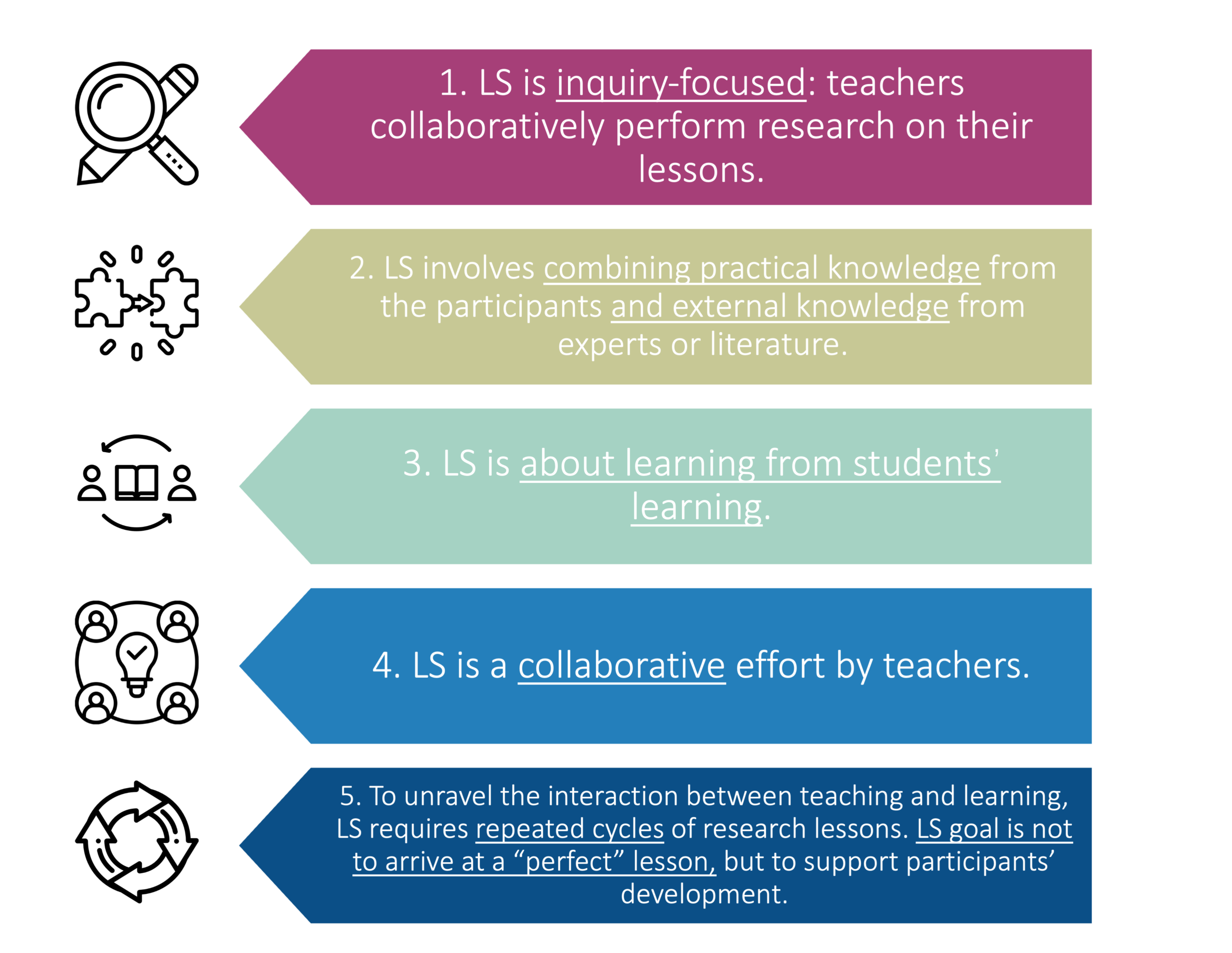
These five big ideas (Goei et al., 2021), can help you familiarize yourself with the key characteristics of LS:

In the case of PSTs, some adaptations from the more common in-service setting need to be made. This flipbook proposes several ways to do so in Chapter 3.

Page 6

2.2 What is the Lesson Study Process like?


LS is often graphically represented as a cycle.

The LS process, with in-service or Pre-Service Teachers, may be described in the following way:


“In a Lesson Study, a group of teachers or a combined group of teachers and Teacher Educators/researchers work together, identifying the students’ difficulties on a given concept or issue, studying the related curriculum guidelines and research results, analysing tasks, and planning what they consider as a suitable lesson to address the proposed concept or issue. This “research lesson” is taught by a member of the group to a class of students, whereas the others observe the lesson with a focus on student learning. The participants seek to verify to what extent this lesson achieves the sought objectives and what difficulties arise. On the basis of this analysis, they may revise the lesson and re-teach it to another class […] Given the focus and the nature of the process, lesson studies may be regarded as a small investigation of the participants carried out on their own professional practice”

(Ponte, 2017, p. 169).

Page 7

Identify issue in teaching and learning


At this stage, the group chooses a topic or an issue to focus on. This topic might be one that causes difficulty for students, is challenging to teach, one that PSTs want to get better at teaching. The topic can be disciplinary and/or cross-disciplinary focused. Before or at the start of the process, participants take time to get acquainted, clarify expectations, and agree on how they will collaborate as a group.


See an agenda template for the lesson study meeting


See how this stage is implemented in Portugal


You can use the conversation card below to guide discussion in this stage. See the complete set here. 

Study material and formulate research question


The study of materials and formulation of a research question is an essential but often overlooked stage. At this stage, the LS group analyses various resources in order to gain a deeper understanding of the initial issue. These resources may consist of official documents (national or school curricula), textbooks, texts from other LS, articles from professional journals, or other materials. At the end of this phase a research question is formulated.


See how this stage is implemented in Portugal


You can use the conversation card below to guide discussion in this stage. See the complete set here. 

Plan research lesson


The LS group plans a research lesson based on the research question and aligned with the larger unit. When planning the research lesson, key components include the flow of the lesson, the observation related to each moment of the lesson and the anticipation of students’ responses.


See a sample lesson plan


See how this stage is implemented in Portugal


You can use the conversation card below to guide discussion in this stage. See the complete set here. 


Lesson plan for a research lesson
Page 8

Teach and observe lesson


A member from the LS group teaches the research lesson while other members purposefully observe according to the lesson-observation plan. Observers usually do not intervene during the lesson.


See a sample agenda for the pre-research lesson briefing meeting 


See a sample schedule for the research lesson day


See a sample of an observation form


See how this stage is implemented in Portugal


You can use the conversation card below to guide discussion in this stage. See the complete set here.


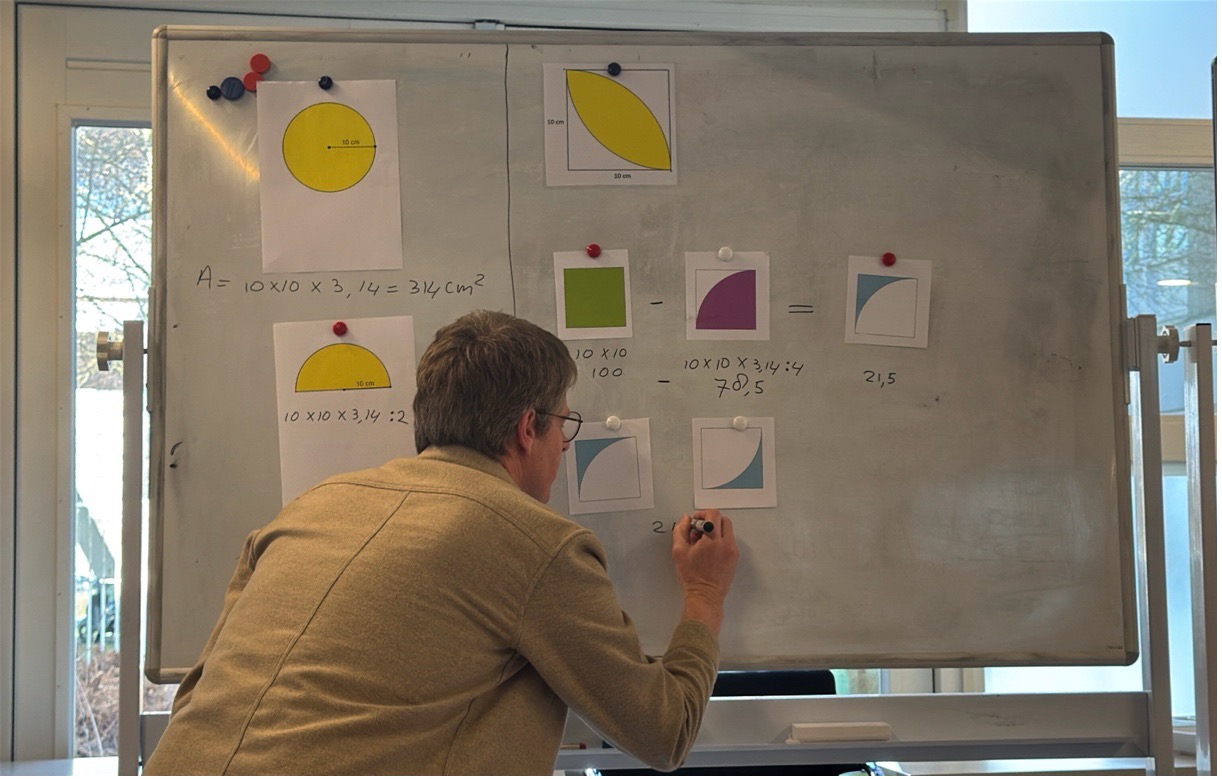
A member of the LS is teaching the research lesson
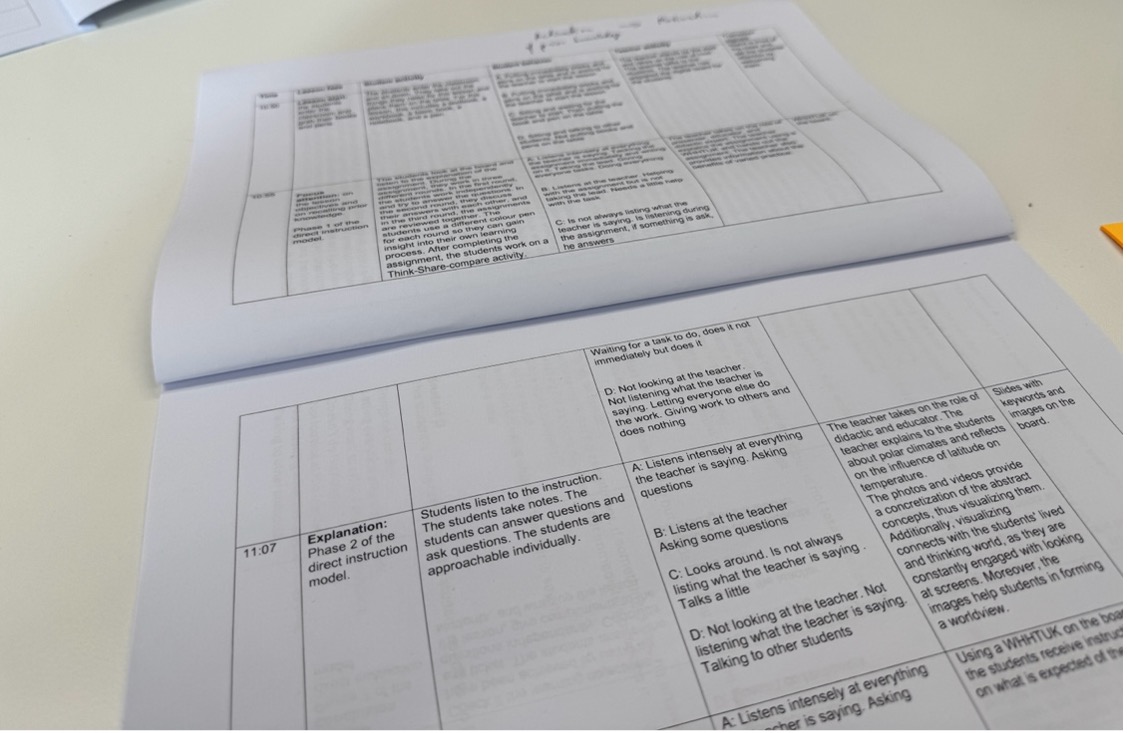
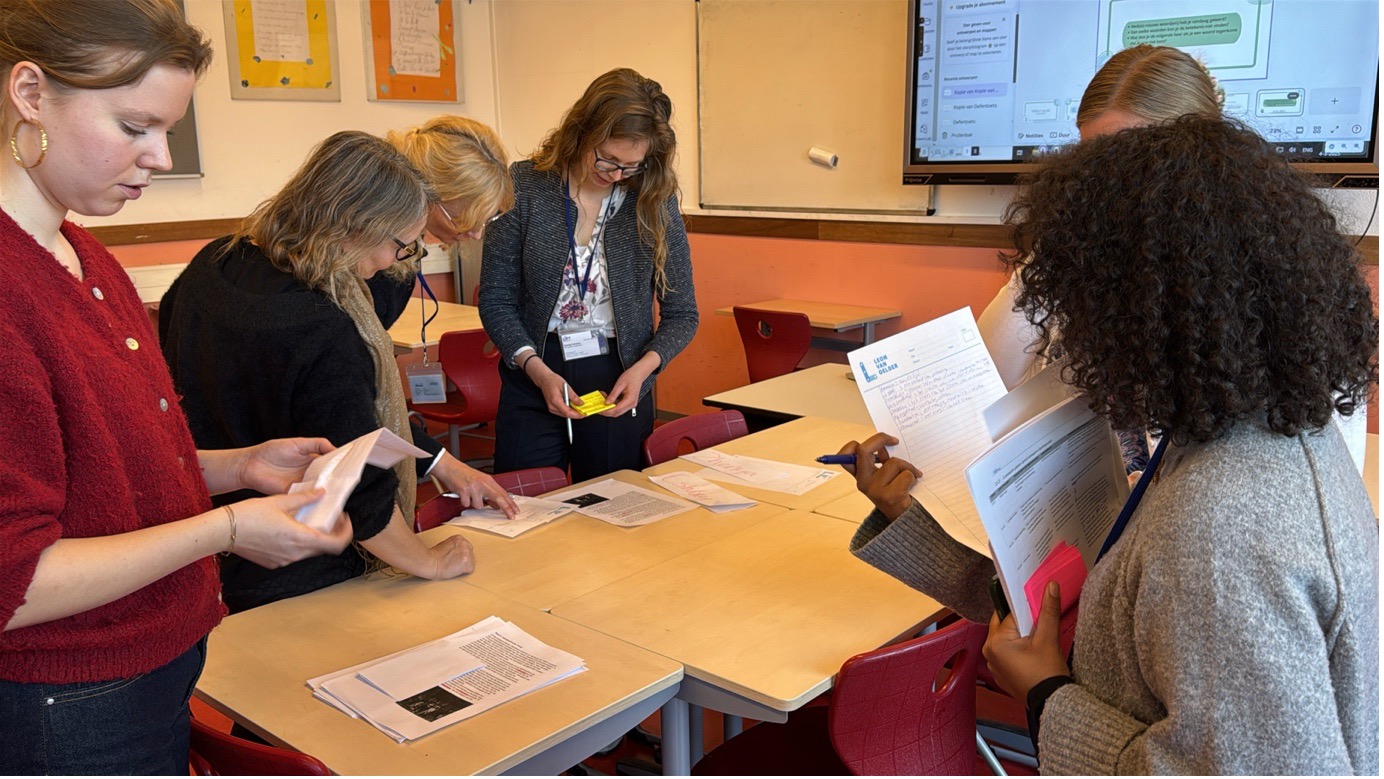
LS groups observing students’ notes after the research lesson
Page 9

Reflect on lesson


The LS group shares their observations and discusses them in relation to the research question. As part of the reflection, the LS group plans modifications or changes to be implemented if the lesson is to be taught in the future. During this phase, an expert member, or koshi, might be present to help the group link theory to practice, highlighting new knowledge and fostering reflection on teaching and learning. In some cases, this expert is also present in the planning stage. If the expert is unavailable, the TE may assume this role.


See a set of reflection questions


See how this stage is implemented in Portugal


You can use the conversation card below to guide discussion in this stage. See the complete set here.

LS group discusses their observation using their field notes

Share Lesson Study report


Utilising the results of the entire LS process, the LS group synthesises their reflection to produce a LS report. This report will be stored as part of a knowledge base and shared with a wider community (other LS groups, department, school, district, university…).


See how this stage is implemented in Portugal


These stages are chronological. Nevertheless, reflections during one stage might lead to revisiting a previous one. For example, a moment of the planning phase might lead to refinement of a part of the study phase or even the research question.

The group may decide to plan a modified version of the research lesson, mainly to better answer the research question.

Page 10

2.3 Who is involved in Lesson Study?


The implementation of LS in ITE requires the active involvement of various stakeholders, such as TEs, mentor teachers, and PSTs. These stakeholders contribute in different ways and may take on multiple roles throughout the LS process. In the subsequent section, we examine these roles and how stakeholders may assume different roles throughout the LS process. While the description provided here is general, please refer to the case studies and the LS variant table for nuances and examples.

Participants:

What are the core responsibilities?

Who can play this role?

  • Engage in LS without taking on additional roles.
  • Take responsibility for driving the LS process by raising questions and issues related to teaching and learning, in line with the teacher-led nature of LS.
  • Contribute actively to collaboration by creating a safe environment for sharing difficulties, ideas, and feedback, and by adopting a learner stance.

Pre-Service Teacher

  • PSTs commonly participate in LS within ITE contexts.
  • Participation offers opportunities to apply learning from previous courses and to practise key aspects of teaching in a more controlled environment than everyday classroom teaching.
  • At the same time, participation may present challenges related to increased responsibility and agency within the process.
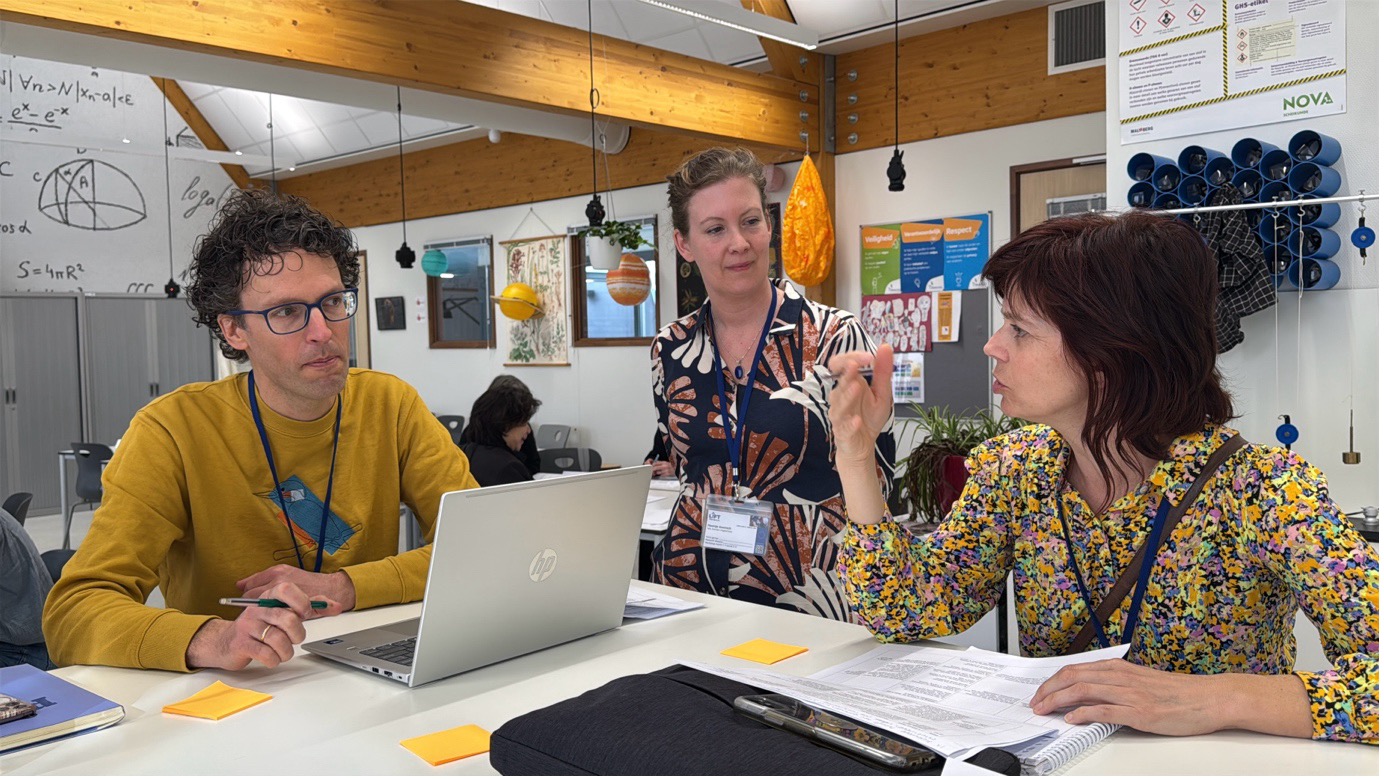
Pre-Service Teachers in a post-lesson discussion
Page 11

Facilitator:

What are the core responsibilities?

Who can play this role?

  • Safeguard the fundamental characteristics of LS by ensuring teacher agency and active collaboration throughout the process.
  • Guide the group through the LS agenda, ensuring that all phases are addressed and that the work progresses in a coherent and timely manner.
  • Actively elicit participation from all group members and monitor group norms to support inclusive and respectful collaboration.
  • Coordinate and organise the practical aspects of the LS process to ease participants’ engagement.
  • Support the quality of discussion by focusing the conversation, highlighting connections between contributions, and encouraging exploratory talk.
  • Create and maintain a safe environment in which participants feel able to share questions, uncertainties, and emerging ideas.


To get examples about what do facilitators do in each step of LS, you could read the case studies. 


See:

  1. How this stage is implemented in Portugal
  2. The variant table for detailed explanation
  3. A guide on facilitation in the Swiss setting

Teacher Educator

  • In ITE, TEs commonly act as facilitators of the LS process.
  • In this role, they typically design the overall LS process, prepare materials in advance, and plan and lead the working phases.
  • During sessions, they facilitate the work while maintaining a low profile, establishing a safe environment, encouraging broad participation, focusing discussion, and supporting exploratory talk.
  • TEs retain their responsibilities as TEs while also assuming facilitation responsibilities; differences in expertise and assessment roles may create power imbalances that can affect collaboration.
  • TEs may also take on the role of koshi (see below); when this occurs, the shift in role should be made explicit.


School-based mentor

  • Depending on the LS variant in ITE, school-based mentors may serve as facilitators (the same as way as TEs as described above), either independently or in collaboration with TEs.
  • Their teaching experience and knowledge of the class and individual pupils can be a distinctive asset in planning and reflecting on the research lesson.
  • Depending on the LS the variant, they may also teach the research lesson.
  • As with TEs, attention should be paid to potential power imbalances and their implications for authentic collaboration.


Pre-Service Teacher

  • In some LS variants in ITE, the facilitator role may be assumed by one PST or shared among PSTs in turn.
  • This may occur when the number of PSTs exceeds the availability of TEs or school-based mentors.
  • As PSTs may have limited experience with LS, additional support materials are important (e.g. conversation cards). For implementation examples, see Dutch Case Study.


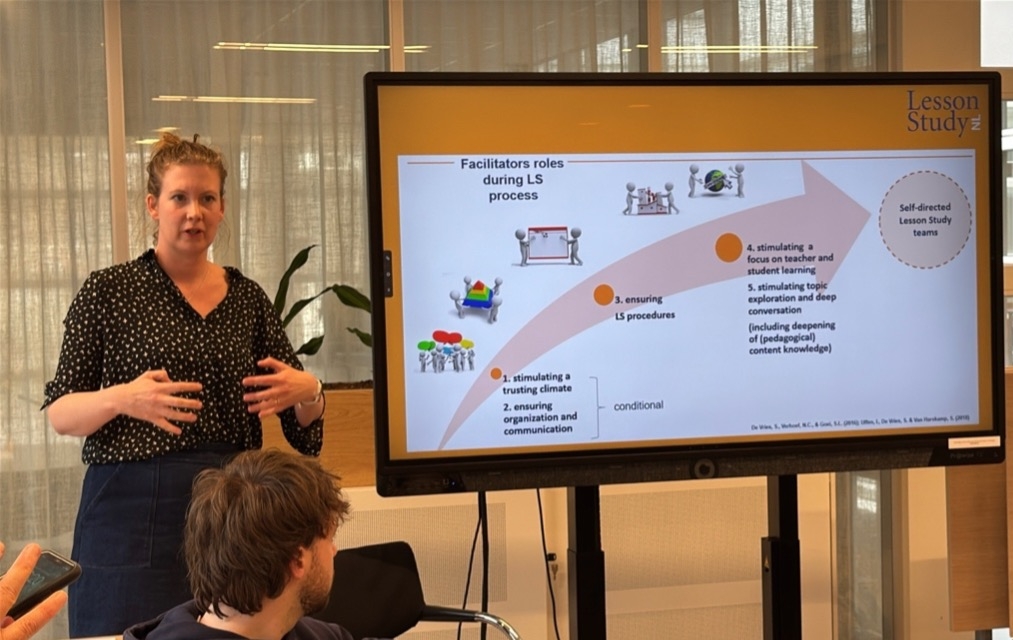
Facilitator outlining key responsibilities during the LS process
Page 12

Koshi:

What are the core responsibilities?

Who can play this role?

  • Draw on recognised teaching or subject-matter expertise and in-depth knowledge of LS to contribute expert perspectives to the LS process (a role often referred to in Japan as koshi, or “knowledgeable other” (see Takahashi & McDougal, 2016).
  • Support the LS group in making connections between theory and practice.
  • Help participants deepen their reflection on teaching and learning, particularly during post-lesson discussions.
  • Offer feedback that extends participants’ thinking while respecting their agency and ownership of the LS process.
  • Adapt the level and timing of contributions according to the LS model or variant (e.g. participation in planning, observation of the research lesson, or final commentary).
  • Make explicit when acting in the role of koshi, particularly when also holding other roles in the LS process.

Teacher Educator

  • TEs may act as koshi by contributing subject-matter, pedagogical, or LS-related expertise.

  • When doing so, they need to balance their own teaching agenda with responsiveness to the group’s research questions and learning needs.

  • It is important to make explicit when the TE is acting in the role of koshi, particularly when they also hold other roles in the LS process.


School-based mentor

  • School-based mentors may take on the role of koshi, providing expert feedback grounded in their teaching experience.

  • Their knowledge of the class and pupils can deepen reflection and support concrete connections between theory and practice.


Others

  • Depending on the LS model or variant, more than one koshi may be involved.

  • These may include teachers from the same school, school administrators, school leaders or other TEs who contribute additional perspectives, particularly during post-lesson discussions.

  • When multiple koshi are present, attention should be paid to ensuring coherence and complementarity in feedback.


Koshi in a post-lesson discussion
Page 13

3. Models and Variants of Lesson Study in Initial Teacher Education


3.1 How do different Lesson Study models work in practice?


In the table below, we present three principal models of LS that are adaptable for ITE programmes. The selection of a particular model may be informed by various contextual factors, including the cohort size of PSTs, the availability and expertise of TEs and school-based mentors, and the alignment of teaching practicums and placements within the same schools.


By offering these diverse models, we aim to provide TEs with practical frameworks and insights that can facilitate the integration of LS within their own institutional settings.


To support this selection process, we have included a decision tree to help you explore which model and variant might suit your particular context. Please use the decision tree as a starting point for reflection, not a definitive or prescriptive guide.


decision tree


The details for each variant are also presented in the Variant Table. To clarify the roles of stakeholders — PSTs, TEs, and school-based mentors — within each variant, we have outlined their specific responsibilities across each stage of the LS cycle that we presented in Section 2.2 (Study, Plan, Teach/Observe, Reflect).

Page 14

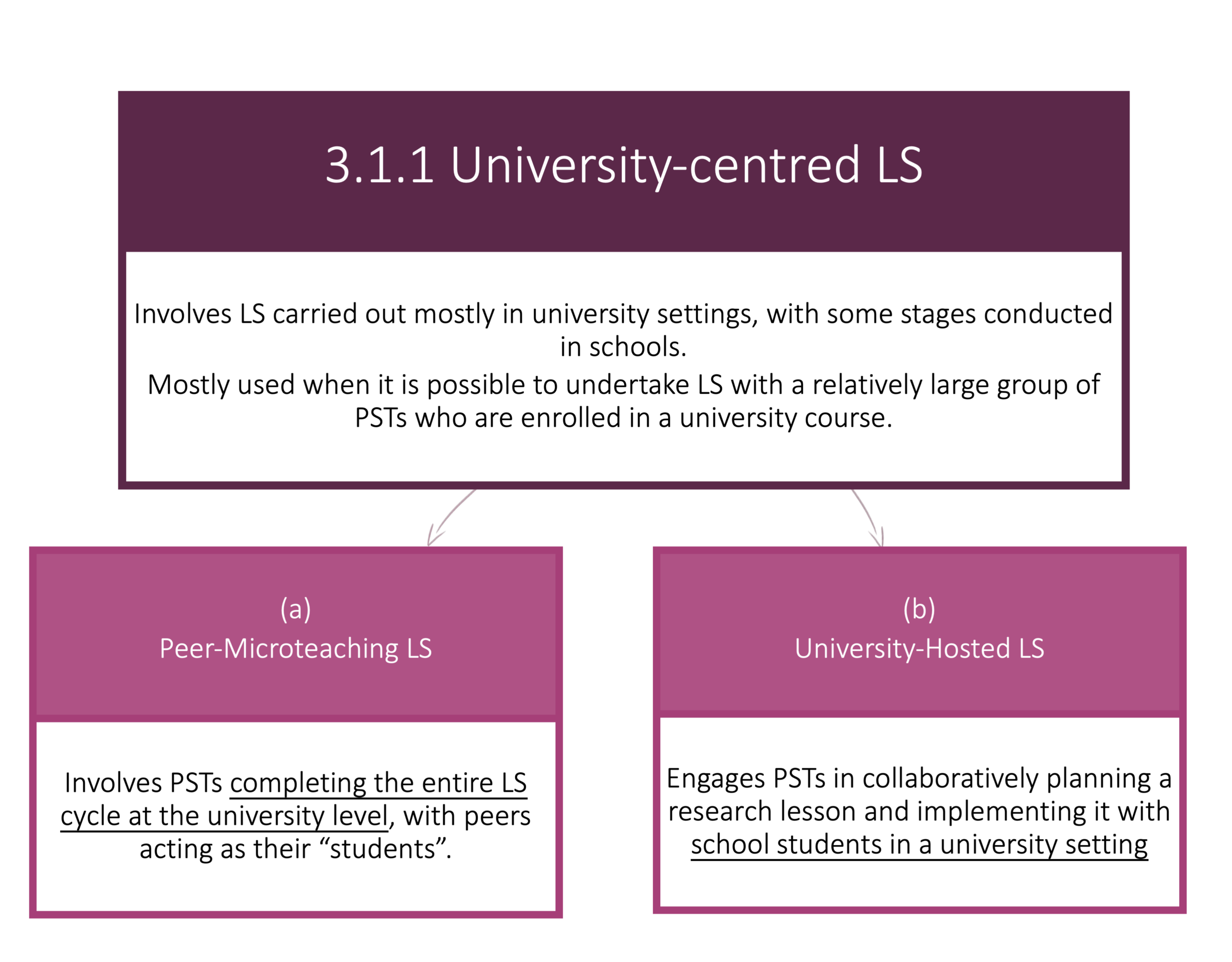
3.1.1 University-centred Lesson Study


(a) Peer-Microteaching LS

Peer-Microteaching LS involves PSTs completing the entire LS cycle at the university level, with peers acting as their “students”. This approach is typically integrated into ITE courses, allowing PSTs to first gain exposure to LS through lectures and coursework before engaging in Peer-Microteaching LS. In this process, PSTs often work in small groups of three to six to plan lessons, receive feedback from TEs and revise their plans collaboratively. The planned lessons are then taught to their peers within the cohort, with observations and feedback provided by TEs and colleagues.


(b) University-Hosted LS

This variant of LS engages PSTs in collaboratively planning a research lesson and implementing it with school students in a university setting. The cycle incorporates a needs-assessment phase in which PSTs interact directly with school students via video calls or face-to-face meetings to gather insights into their interests and needs. The school students are subsequently invited to the university, where the collaboratively designed lesson is conducted, allowing PSTs to apply their planning in an instructional context informed by the learners’ input.

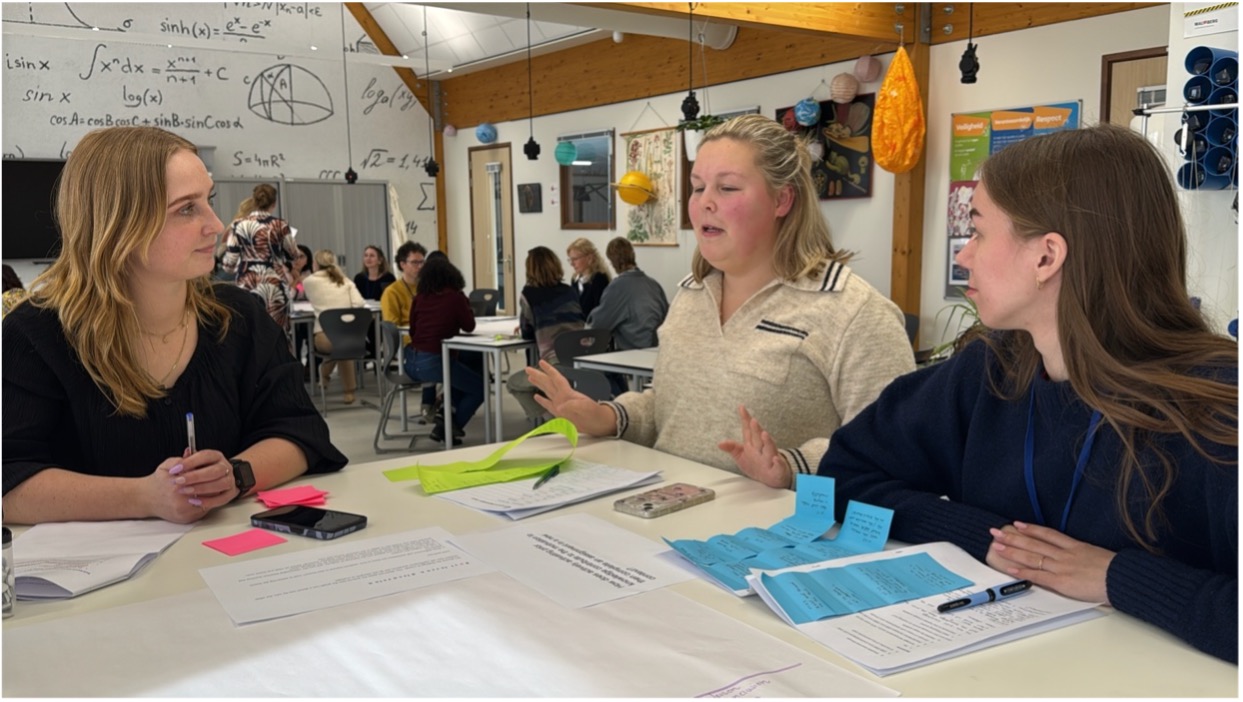
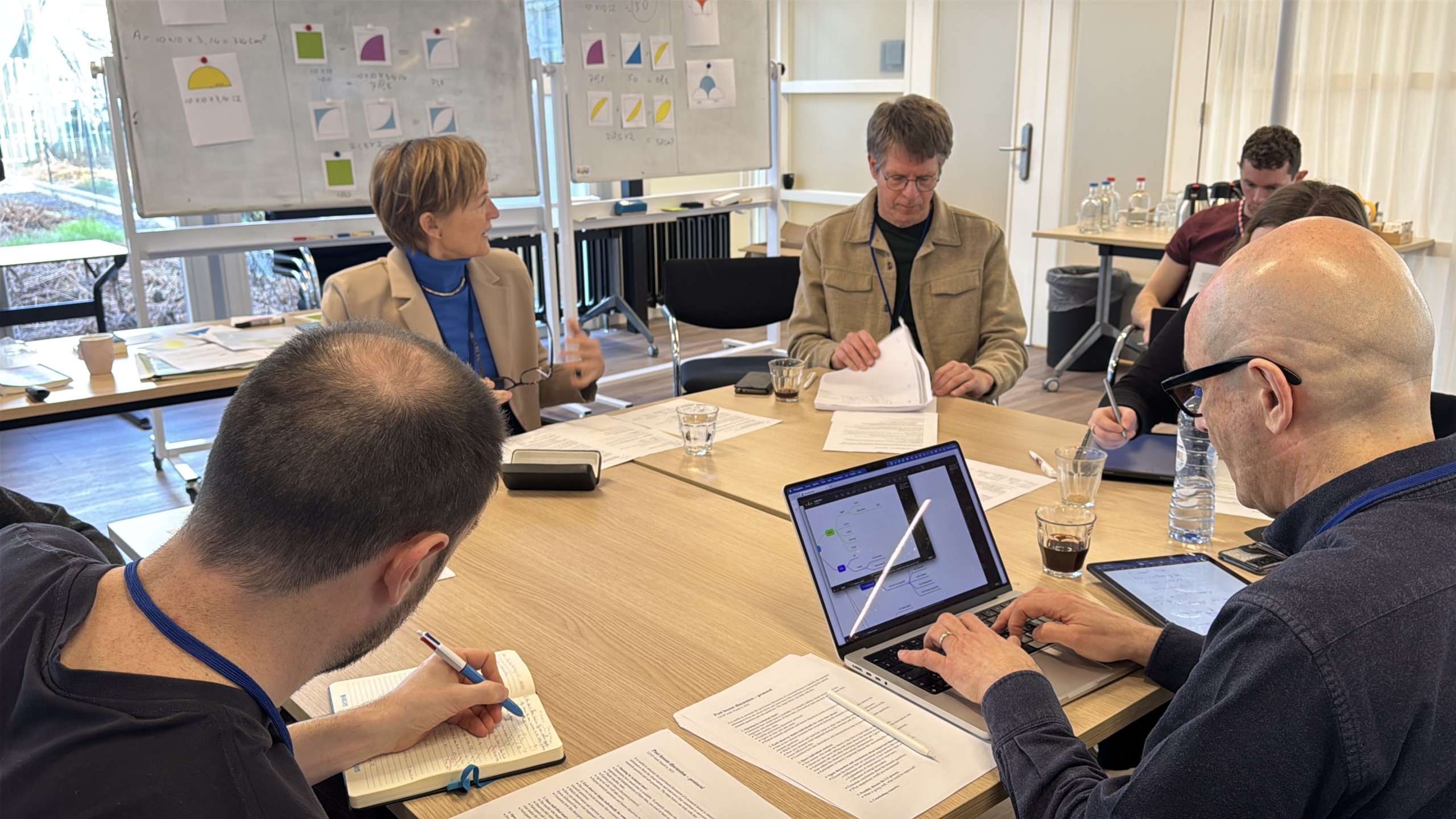
Lesson study team in a post-lesson discussion
Page 15

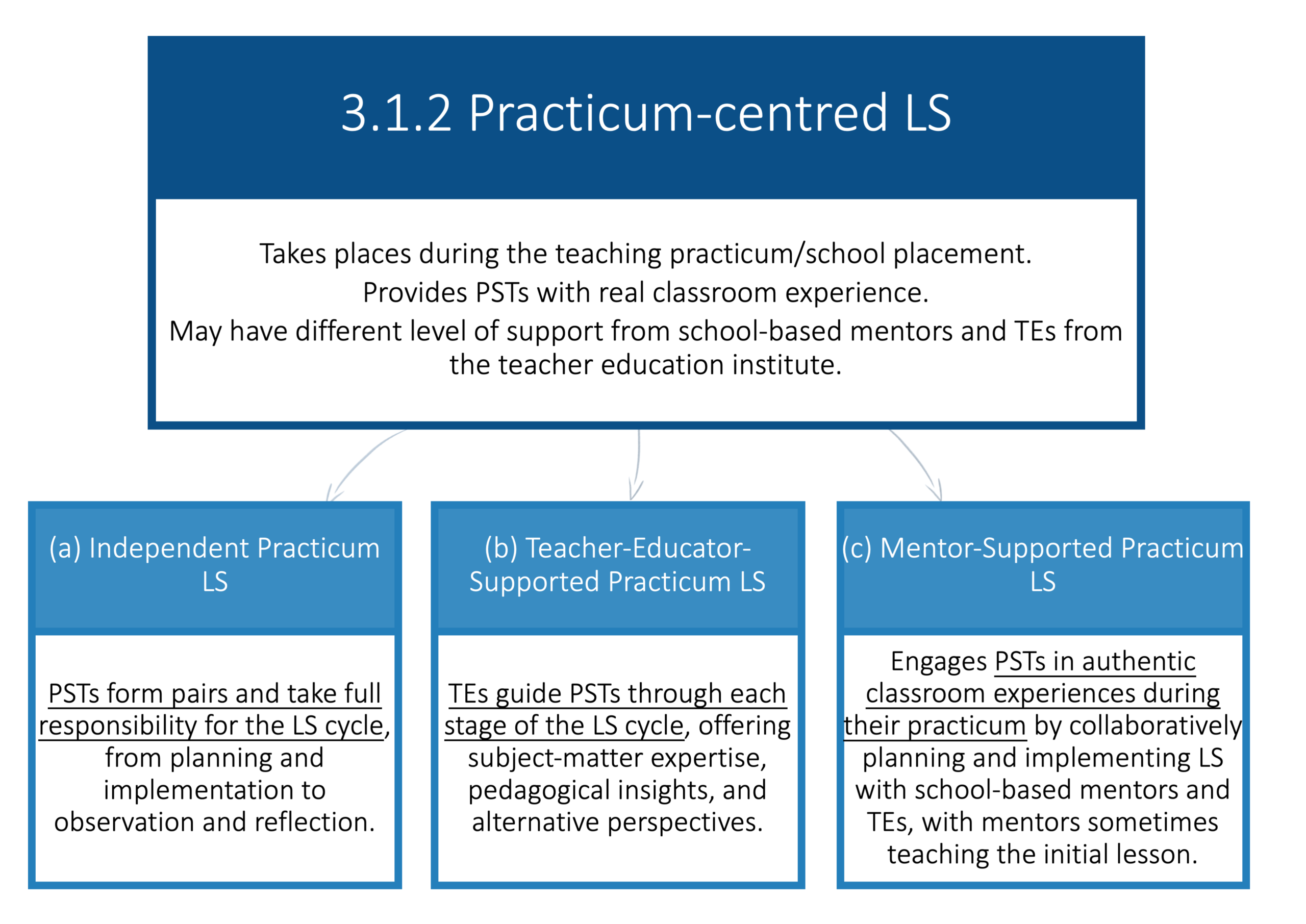
3.1.2 Practicum-centred Lesson Study


(a) Independent Practicum LS

In the practicum-centred model, this variant of LS emphasises the autonomy of PSTs by removing the requirement for a school-based mentor during their practicum. Instead, PSTs form pairs and take full responsibility for the LS cycle, from planning and implementation to observation and reflection. Working collaboratively, each pair designs and teaches a lesson while the partner observes, followed by joint reflection to discuss evidence of student learning and areas for improvement. This peer-driven process nurtures professional independence, encourages critical dialogue, and strengthens PSTs’ capacity to give and receive constructive feedback. It also allows them to experience LS as a self-sustained, flexible model adaptable to diverse practicum contexts.


(b) Teacher-Educator-Supported Practicum LS

This variant of LS centres on strong support from TEs during the practicum phase. In this model, TEs guide PSTs through each stage of the LS cycle, offering subject-matter expertise, pedagogical insights, and alternative perspectives. Acting as advisors rather than supervisors, TEs are invited by PST groups to contribute ideas, attend the research lessons, and participate actively in post-lesson discussions. This collaborative structure positions the TEs as facilitators of reflective dialogue and professional growth, helping PSTs connect theory with classroom practice while maintaining ownership of their learning process.


(c) Mentor-Supported Practicum LS

This approach focuses on providing PSTs with authentic classroom experiences in a school setting during their teaching practicum. It typically involves PSTs collaborating with school-based mentors and TEs to implement the LS process. In this approach, PSTs, TEs and school-based mentors often work together to plan lessons, with mentors sometimes teaching the initial lesson. Feedback and reflections are used to identify challenges and make improvements, after which PSTs reteach the lesson to apply these refinements. Collaborative observation and post-lesson discussions are integral to this process, often involving school-based mentors, TEs and peers.

Page 16

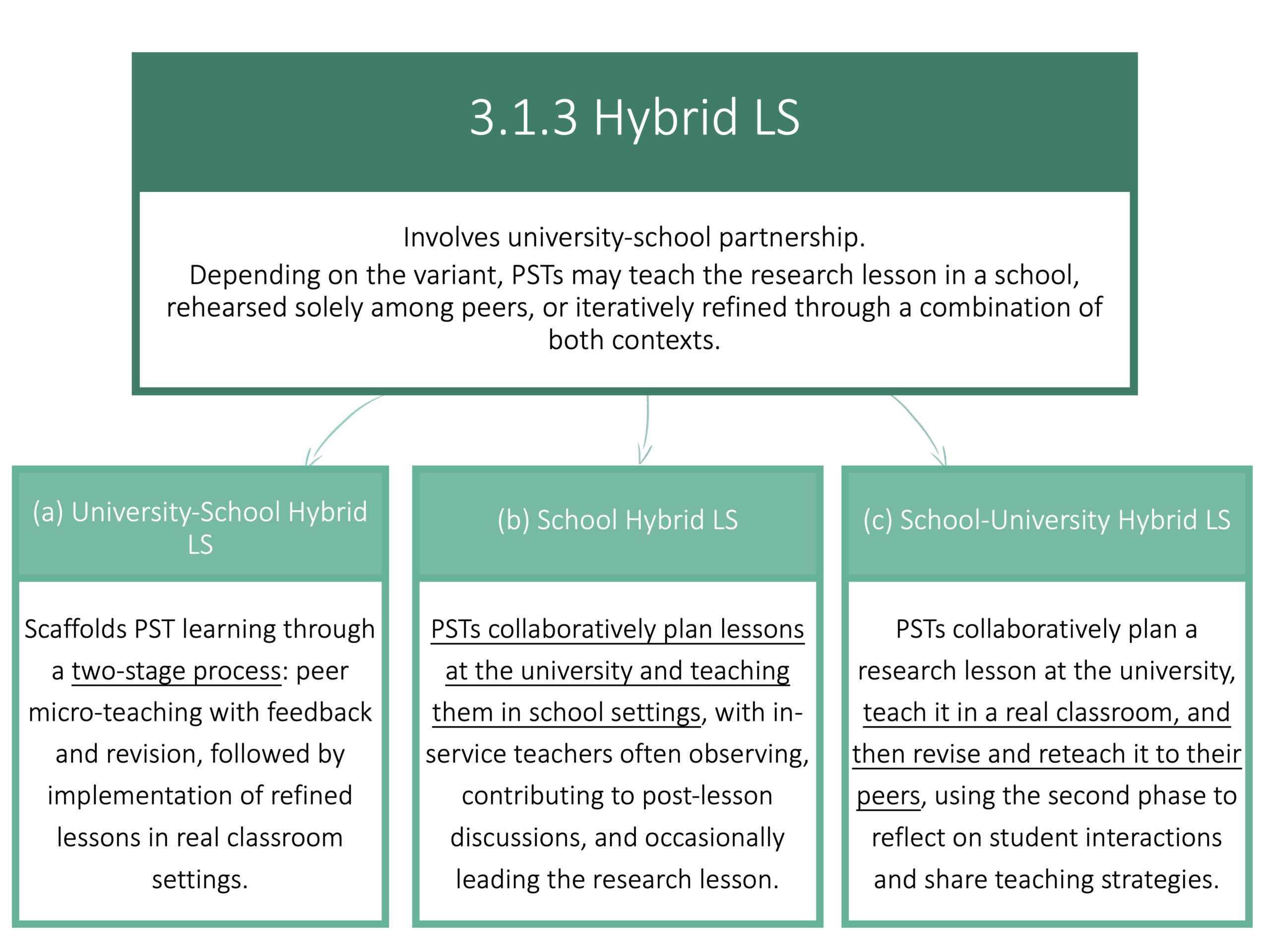
3.1.3 Hybrid Lesson Study


(a) University-School Hybrid LS

This variant of LS integrates two stages of teaching to scaffold PSTs’ learning. In the first stage, PSTs conduct peer micro-teaching sessions, treating their peers as students to test and refine their lesson plans in a safe, low-stakes environment. TEs and peers provide targeted feedback after each session, enabling PSTs to revise and improve their lesson plans through one or more cycles of reflection and adjustment. In the second stage, the revised lessons are implemented in real classroom settings with school students. This progression from peer micro-teaching to authentic teaching supports PSTs in developing confidence, pedagogical skills, and adaptive lesson design practices, while also allowing TEs to align course instruction with PSTs’ observed needs.


(b) School Hybrid LS

PSTs are introduced to the LS process as part of the ITE course. They collaboratively plan lessons at the university and then teach the research lesson in a school setting with school students. Since the lesson is conducted in the field, in-service teachers often participate by observing the research lesson and contributing to post-lesson discussions. In some cases, the lesson is taught by an in-service teacher.


Case Study: Portugal


(c) School-University Hybrid LS

This variant involves PSTs collaboratively planning the research lesson at the university, teaching it in a real classroom with school students, and then revising and reteaching it to their peers at the university. The reteaching phase focuses on addressing student interactions and questions from the school-based research lesson, while also providing an opportunity for PSTs to share their reflections and teaching strategies with classmates.

Page 17

4. Going into Practice

4.1 How can your context shape the way you do Lesson Study?


Given the wide range of Lesson Study (LS) variants in Initial teacher Education (ITE), we have included a decision tree to support the selection of a contextually appropriate variant. It considers factors such as the location of LS implementation and involvement level of stakeholders, though these are only some of the many considerations that may arise in practice. This section highlights additional considerations that can shape how LS works in your setting. These factors, drawn from varied research contexts, provide insights into conditions, resources, and adaptations that can shape the design and effectiveness of different LS variants.


4.1.1 Time allocation for Lesson Study


This includes practical considerations such as the overall timeline of the cycle, the number of meetings scheduled, and the duration of each meeting. These elements can significantly affect how deeply participants can engage in planning, observation, and reflection, and may need to be adjusted to align with institutional schedules or participant availability.


4.1.2 Group size


The number of participants in a LS group is influenced by various factors, some of which may conflict with one another. One of the main factors is institutional constraints, which pertain to the conditions within the institution where the LS is to be conducted. This includes considerations such as the number of Pre-Service Teachers (PSTs), the PST/Teacher Educator (TE) ratio, and the availability of school-based mentors and classes. These constraints can sometimes conflict with the need to encourage active participation and collaboration among group members as much as possible.


Other factors to consider include the previous experience of group members with LS and the level of comfort among them. From this perspective, these factors can impact the autonomy of participants. If members are already familiar with the structure and dynamics of LS, they are likely to be more autonomous. Consequently, the TE may be able to support more groups, allowing for smaller group sizes.

Therefore, the number of participants in each group must be carefully considered, but there is no definitive “right” number. Based on our experience and the existing literature, we recommend forming groups consisting of two to five PSTs, with a maximum of six, if possible.


4.1.3 Presence of educators


This may include a facilitator, who guides discussions, maintains focus, and ensures progress through each phase, or a koshi (knowledgeable other) who provides subject-matter expertise. The presence of either depends on availability, and in some cases, one person may serve in both roles. It is therefore essential to define these roles clearly, even when they are performed by the same individual.

Page 18

4.1.4 Presence of other Pre-Service Teachers


When multiple PSTs are placed at the same practicum school, it creates a shared teaching environment that supports collaboration, peer observation, and joint reflection. Working in similar classroom contexts allows PSTs to co-plan lessons more easily, observe each other’s teaching in real time, and reflect on comparable student interactions. This factor also expands the range of feasible LS variants. For example, it makes it possible to form a LS group within the same school, enabling more active involvement from school-based mentors. It also supports a more concentrated, practicum-centred LS model, rather than relying on hybrid arrangements that span both university and school settings.


4.1.5 Phase of Initial Teacher Education where Lesson Study is implemented.


The phase of ITE in which LS is implemented is also a factor to consider.  LS can take place at different points in the programme, at the beginning, before the teaching practicum, or during the practicum itself, and each timing serves a distinct purpose. When introduced early, it can help PSTs to build foundational collaboration and inquiry skills; when positioned before the practicum, it allows them to test and refine lesson planning in a low-stakes environment; and when integrated during the practicum, it supports direct application of learning in authentic classroom contexts. The chosen phase, therefore, shapes both the focus and depth of the LS experience.


4.1.6 Grading/Evaluation of the LS project


Another contextual factor is the grading or evaluation of the LS project. In some programmes, LS is formally graded, while in others it functions as a formative, non-assessed activity. These different approaches can influence how PSTs engage with the LS process and what aspects of their work are made visible, such as planning, collaboration, teaching, or reflection, as well as the timing of any evaluation.

Across contexts, TEs make different choices about how to approach evaluation in ways that align with their programme goals. For example, some prefer broad forms of recognition, such as pass/fail decisions, rather than detailed numerical grades. Others focus evaluation not on the individual PST but on process-oriented elements of the LS experience, including the quality of reflection, collaborative work, or engagement with inquiry.


There are also programmes in which reflection reports are read after any formal evaluation, with the intention of encouraging PSTs to write openly about their learning rather than shaping their reflections to meet perceived assessment expectations. In addition, some contexts make use of portfolios to document learning across the LS cycle, allowing multiple forms of evidence to be brought together over time.


However, in all cases, the teaching performance of a PST teaching the research lesson should not be evaluated.


4.2 Lesson Study project across Europe


Though this flipbook focuses on LS in ITE, many excellent resources have been developed to guide In-Service Teachers (ISTs) which may be of interest to readers.


Three examples are included here:


  1. A guide on facilitation in the Swiss setting

    (Hoznour et al., 2024). 


  2. A guide for ISTs in the Irish setting

    (Owens et al., 2023).


  3. A guide for ISTs in the European context
    with a focus on reasoning in mathematics (Barbier et al., 2023).
Page 19

4.3 How can ethical, respectful and safe practices be ensured in Lesson Study?


4.3.1 Establishing a safe space for open and productive discussion


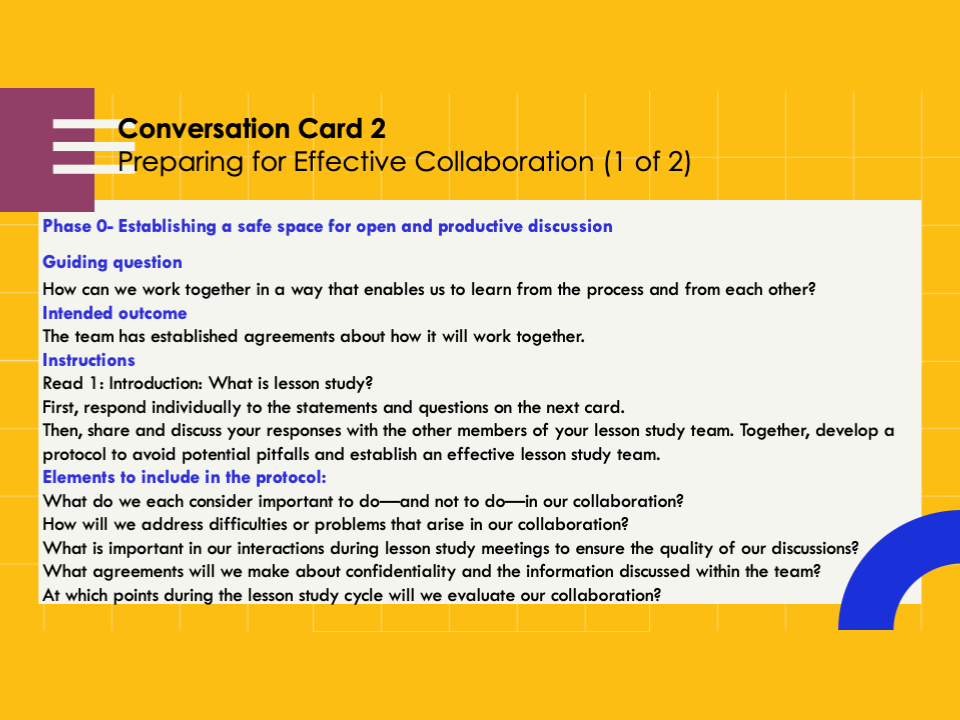
Before the LS, it is essential to establish a safe space for open and productive discussions. This requires a comprehensive and inclusive strategy to create a secure learning environment for all participants. It involves proactive measures to reach an agreement and consensus on collaboration methods, emphasising respectful communication and the involvement of all stakeholders. This approach ensures a supportive atmosphere for every participant in the LS and every learner. The following conversation cards may prove useful.

You can find a text version for easy copy and paste, along with the full card set, here.


Page 20

4.3.2 When observing students in the research lesson


Before the research lesson, a member of the LS team should explain the process to the students in the lesson. An essential part of this is the clarification that the focus of the observers is on students’ learning and not an evaluation of their performance.


During the research lesson, the observers note anything about the student(s) that may inform the research question. In general, observers do not interfere with the lesson itself. This can often be challenging for observers, especially for members of the LS team. For this reason, developing observation protocols may be beneficial.

4.3.3 Storing collected data in a safe space


In a LS, a substantial amount of information and data is typically gathered. The research lesson design includes a section in the LS plan that outlines the data collection methods, such as how observations will be conducted, which students will be interviewed, which student work will be utilised, what artefacts will be collected, and what additional information is necessary to address the research question.


This section also details how observations are recorded via audio and video, and whether active consent is required from the participating students and, if they are minors, from their parents or guardians, especially if this is not covered by the school’s data management plan.


During the preparation phase of the LS, it is also advisable to discuss where all developed artefacts, collected data, and information will be stored, such as on a shared drive like a Teams environment, SURF, One Drive, or a secure server like Research Drive, for the duration of the LS.


This information should be explicitly stated in the consent form, including where the data will be stored and how it will be used. The data collected in this study are confidential and largely context-specific. These data must be stored on a secure server for the duration of the LS. The team needs to discuss who will have access to the data, who will have restricted access, and when the data will be deleted after use.

Page 21

Conversation cards

The conversation cards are practical tools for structuring dialogue within the Lesson Study team during the different stages of the Lesson Study process. Instead of slipping into general evaluations (e.g. “the lesson went well”), these cards shift the focus to students’ learning processes and behaviour. Each card provides guiding questions, prompts, and activities to help teams discuss and work through a particular aspect of the process.

The conversation cards used in the LIFT flipbook are adapted from the “gesprekskaarten” in Basisboek Lesson Study in de lerarenopleiding [A Handbook of Lesson Study for Initial Teacher Education] (De Vries, Goei, & Verhoef, 2023). They were originally developed by Carien Bakker (Bakker et al., 2022) for initial teacher training at the University of Groningen.

These cards have been translated, adapted, and reorganised to align with the five stages of the LIFT Lesson Study process presented in the flipbook.

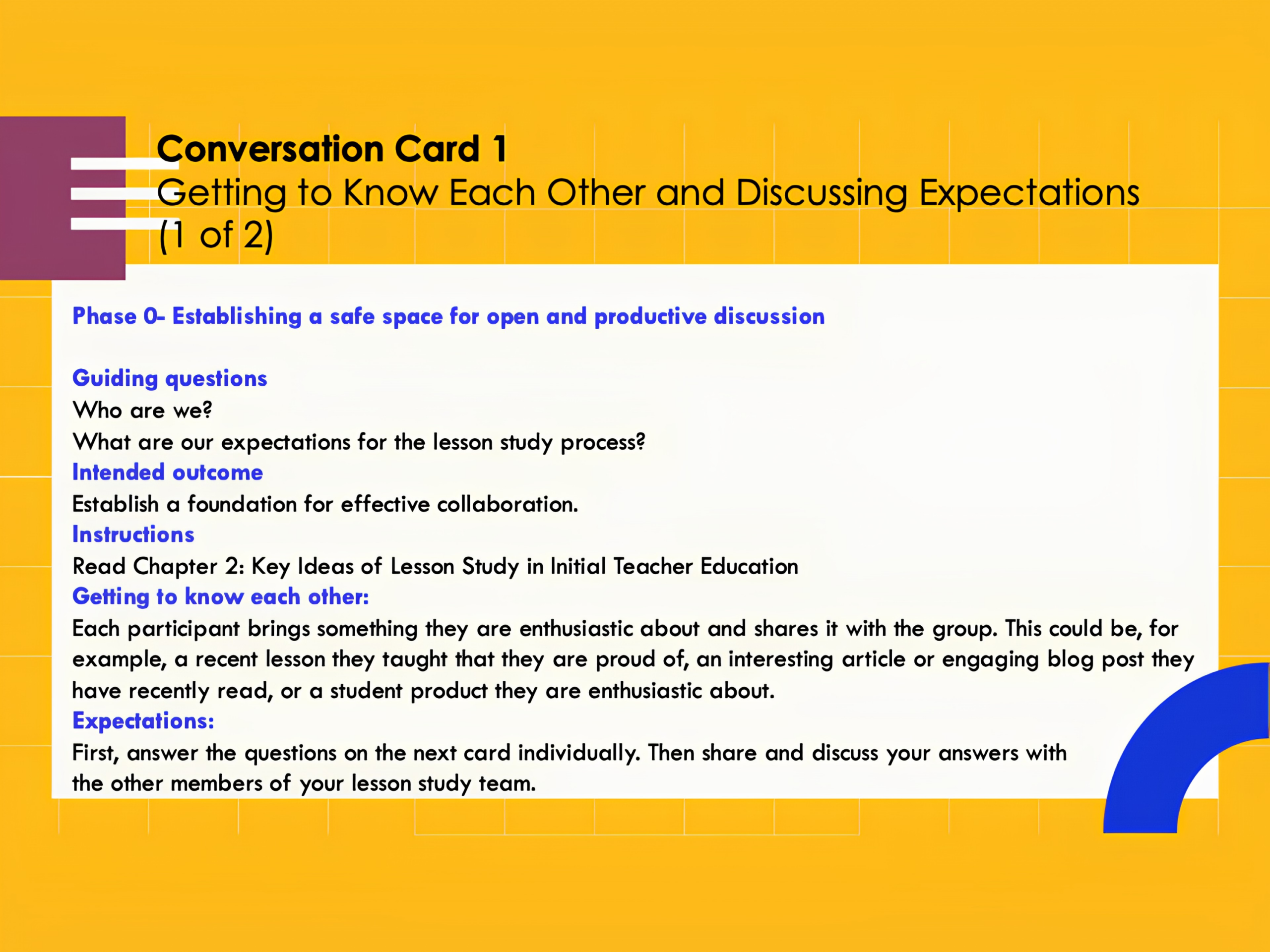
Conversation Card 1 – Getting to Know Each Other and Discussing Expectations

1 of 2

Phase
0- Establishing a safe space for open and productive discussion
Guiding questions
• Who are we?
• What are our expectations for the lesson study process?
Intended outcome
Establish a foundation for effective collaboration.
Instructions
Read Chapter 2: Key Ideas of Lesson Study in Initial Teacher Education
Getting to know each other:
Each participant brings something they are enthusiastic about and shares it with the group. This could be, for example, a recent lesson they taught that they are proud of, an interesting article or engaging blog post they have recently read, or a student product they are enthusiastic about.
Expectations:
First, answer the questions on the next card individually. Then share and discuss your answers with the other members of your lesson study team.

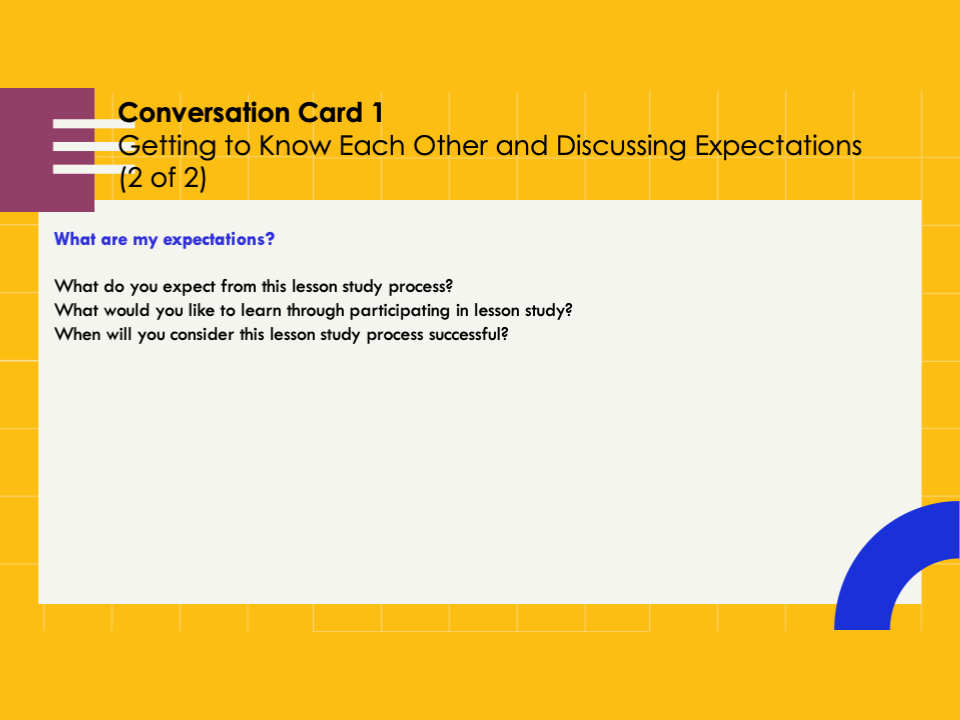
2 of 2

What are my expectations?

  • What do you expect from this lesson study process?
  • What would you like to learn through participating in lesson study?
  • When will you consider this lesson study process successful?

Conversation Card 2 – Preparing for Effective Collaboration

1 of 2

Phase
0- Establishing a safe space for open and productive discussion
Guiding question
How can we work together in a way that enables us to learn from the process and from each other?
Intended outcome
The team has established agreements about how it will work together.
Instructions
Read 1: Introduction: What is lesson study?
First, respond individually to the statements and questions on the next card.
Then, share and discuss your responses with the other members of your lesson study team. Together, develop a protocol to avoid potential pitfalls and establish an effective lesson study team.
Elements to include in the protocol:

  • What do we each consider important to do—and not to do—in our collaboration?
  • How will we address difficulties or problems that arise in our collaboration?
  • What is important in our interactions during lesson study meetings to ensure the quality of our discussions?
  • What agreements will we make about confidentiality and the information discussed within the team?
  • At which points during the lesson study cycle will we evaluate our collaboration?

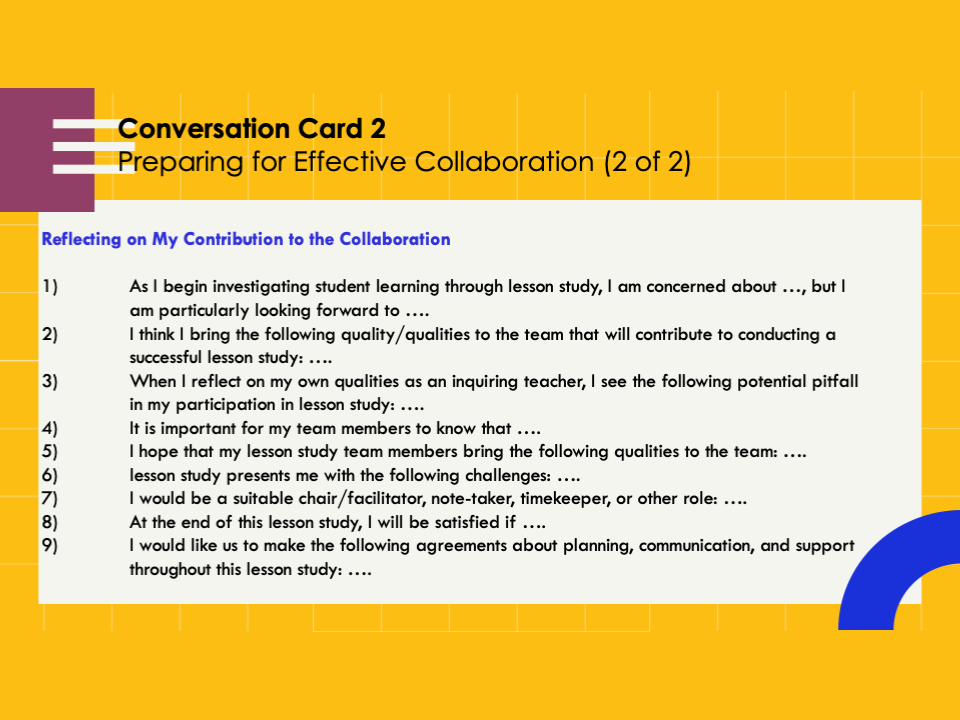
2 of 2

Reflecting on My Contribution to the Collaboration


  1. As I begin investigating student learning through lesson study, I am concerned about …, but I am particularly looking forward to ….
  2. I think I bring the following quality/qualities to the team that will contribute to conducting a successful lesson study: ….
  3. When I reflect on my own qualities as an inquiring teacher, I see the following potential pitfall in my participation in lesson study: ….
  4. It is important for my team members to know that ….
  5. I hope that my lesson study team members bring the following qualities to the team: ….
  6. Lesson study presents me with the following challenges: ….
  7. I would be a suitable chair/facilitator, note-taker, timekeeper, or other role: ….
  8. At the end of this lesson study, I will be satisfied if ….
  9. I would like us to make the following agreements about planning, communication, and support throughout this lesson study: ….

Conversation Card 3 – Communication and Metacommunication

1 of 2

Phase
0- Establishing a safe space for open and productive discussion
Guiding question
How can we engage in effective lesson study dialogue?
Intended outcome
An understanding of the characteristics of high-quality lesson study dialogue and agreements about how the team will work together.
Instructions
Read Chapter 2.3: Who is involved in Lesson Study?
Discuss how you can ensure that your conversations develop in the way you want them to.

  • What are your potential pitfalls?
  • What implications does this have for the agenda of your lesson study meetings?
  • What implications does this have for the roles within the team (e.g., chair/facilitator, note-taker)?
  • Could your communication be improved? If so, use the discussion agenda on the next card to provide structure.

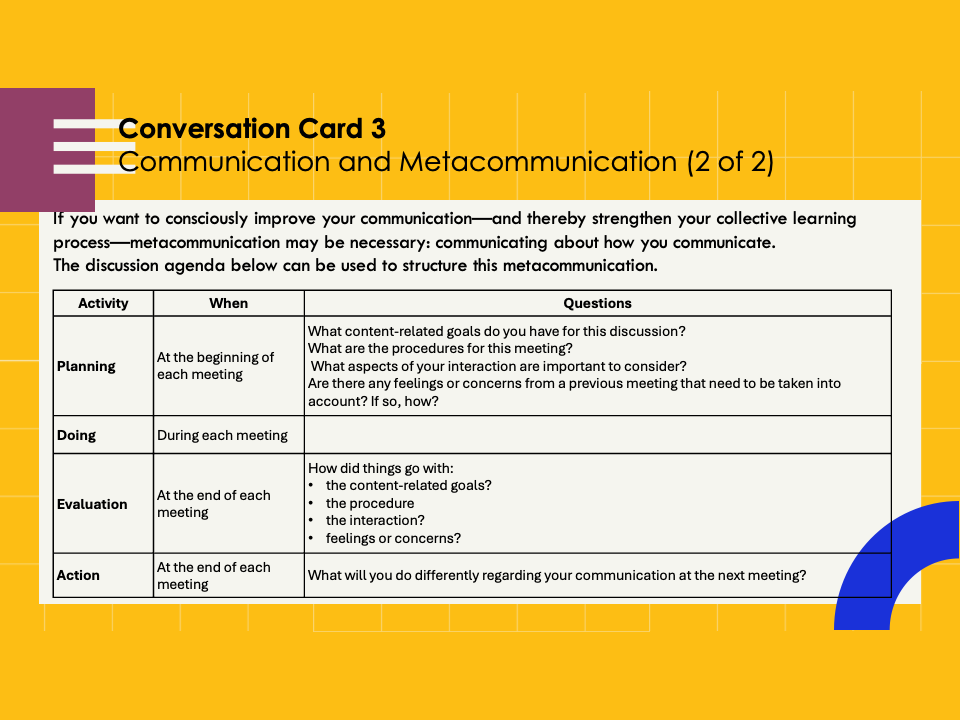
2 of 2

If you want to consciously improve your communication—and thereby strengthen your collective learning process—metacommunication may be necessary: communicating about how you communicate.
The discussion agenda below can be used to structure this metacommunication.


Activity When Questions

Planning

At the beginning of each meeting

• What content-related goals do you have for this discussion?
• What are the procedures for this meeting?

• What aspects of your interaction are important to consider?
• Are there any feelings or concerns from a previous meeting that need to be taken into account? If so, how?


Doing

During each meeting


Evaluation

At the end of each meeting

• How did things go with:
– the content-related goals?
– the procedure
– the interaction?
– feelings or concerns?

Action

At the end of each meeting

• What will you do differently regarding your communication at the next meeting?

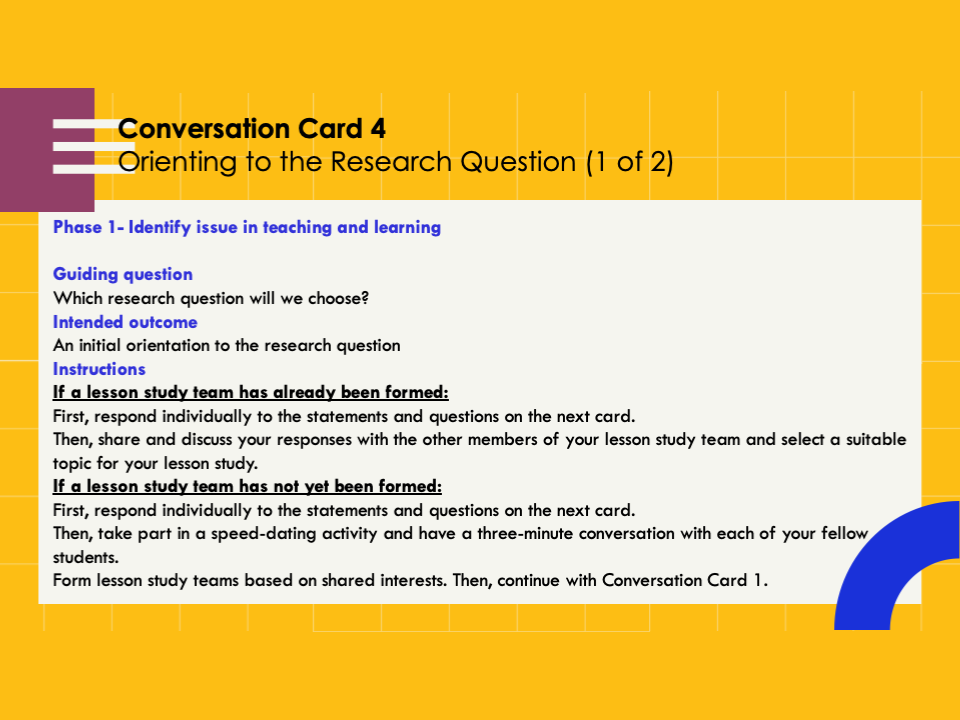
Conversation Card 4 – Orienting to the Research Question

1 of 2

Phase 
1 – Identify issue in teaching and learning 
Guiding question 
Which research question will we choose? 
Intended outcome 
An initial orientation to the research question 
Instructions 
If a lesson study team has already been formed: 
First, respond individually to the statements and questions on the next card. 
Then, share and discuss your responses with the other members of your lesson study team and select a suitable topic for your lesson study. 
If a lesson study team has not yet been formed: 
First, respond individually to the statements and questions on the next card. 
Then, take part in a speed-dating activity and have a three-minute conversation with each of your fellow students. 
Form lesson study teams based on shared interests. Then, continue with Conversation Card 1. 
 

2 of 2

Exploring Possible Research Question 

  1. Which topic have you found most difficult to explain so far? What made it difficult?
  2. Which topics are you particularly enthusiastic about? Which topics make you break out in a “cold sweat”?
  3. Which topics do you feel most confident teaching? Which do you feel least confident teaching?
  4. Which topics have students found most difficult so far? Which have they found least difficult? What did you notice that indicated this?
  5. Which topics have students been particularly motivated to learn? Which have they been less motivated to learn? What did you notice that indicated this?
  6. Which topics are included in the curriculum for your classes around the time when you will conduct the research lesson? What do students typically find difficult about these topics?
  7. Are there any new topics in the curriculum, new teaching approaches, or new learning materials that you would like to try out?
  8. Are there any topics or ideas from the literature or theory that you would like to explore in your lesson study?
  9. Complete the following sentence: 
    If I could get an answer to the following question about student learning, I would consider this lesson study worthwhile: 
    ………………………………………………………………………… 
     

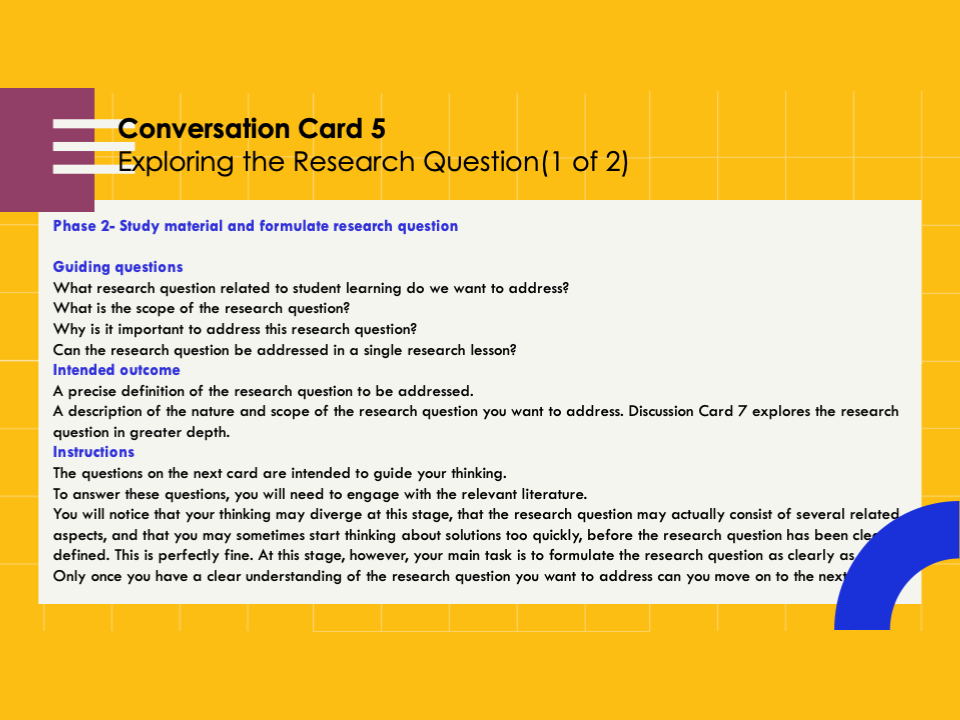
Conversation Card 5 – Exploring the Research Question

1 of 2

Phase 
2 – Study material and formulate research question 
Guiding questions 

  • What research question related to student learning do we want to address?
  • What is the scope of the research question?
  • Why is it important to address this research question?
  • Can the research question be addressed in a single research lesson?

Intended outcome 

  • A precise definition of the research question to be addressed.
  • A description of the nature and scope of the research question you want to address. Discussion Conversation Card 7 explores the research question in greater depth. 

Instructions 
The questions on the next card are intended to guide your thinking. 
To answer these questions, you will need to engage with the relevant literature. 
You will notice that your thinking may diverge at this stage, that the research question may actually consist of several related aspects, and that you may sometimes start thinking about solutions too quickly, before the research question has been clearly defined. This is perfectly fine. At this stage, however, your main task is to formulate the research question as clearly as possible. 
Only once you have a clear understanding of the research question you want to address can you move on to the next stage. 
 

2 of 2

Reflection Questions 

  1. Is your research question related to students’ knowledge, skills, or attitudes? What is its relationship to the attainment targets, core objectives, or your personal vision of good education?
  2. How significant is the research question? Do all students experience this difficulty? Which students do, and which do not?
  3. Is the research question important enough to address? What will students miss or experience if the research focus is not addressed?
  4. Is the research question sufficiently focused to be addressed in a single research lesson? 

Ideas for exploratory preliminary investigations 

  • Use a questionnaire or exit ticket for the whole class, for example via Google Forms, asking students how they usually approach a particular task, how difficult they find the task, and in which situations they find it difficult to approach the task.
  • Ask several students to think aloud while carrying out a task.
  • Analyse a completed homework assignment or test.
  • Ask students to formulate questions about the learning content. 

Note: Students generally find it interesting to participate in research, so do not hesitate to ask for volunteers. 
 

Conversation Card 6 – Possible Explanations for the Research Question

1 of 2

Phase 
2 – Study material and formulate research question 
Necessary prior knowledge 
The nature and scope of the research question are clear. 
Guiding question 
What explanations can we develop for why the research question has emerged? 
Intended outcome 
A range of possible explanations, considered from multiple perspectives. 
Instructions 

  1. Study the example on the next card, in which explanations for a difficulty in student learning are explored from different perspectives.
  2. Based on your own experiences, those of the teacher educators or school-based mentors, preliminary investigations with students, and relevant research literature, formulate possible explanations for your research focus. Try to consider multiple perspectives. The more perspectives you explore, the richer your understanding will be.
  3. Share and discuss your ideas. Identify what you need to find out more about and how you will investigate this further. 
     

2 of 2

Example 
The research question is that students find it difficult to formulate and justify their own appropriate interpretation of an ambiguous literary story. We think that students may find it particularly difficult that there is no single, clearly correct answer, as well as analysing a literary text for ambiguous aspects related to the way the story is narrated. One possible explanation is that students of this age (14 years) may not yet be sufficiently aware of the literary mechanisms at work in a story and of how these mechanisms can influence their reading experience and interpretations. 
In the reading comprehension instruction students have received so far, they have mainly been encouraged to read selectively in order to identify the correct answer to a question. In addition, our subject departments tend to prioritise reliability over validity when designing assessments. As a result, questions that require students to develop their own interpretation occur relatively rarely—not only in literature, but also in other subject areas. 
Another possible explanation is that the teaching materials students use contain few tasks that require them to develop their own interpretation. Moreover, when narrative perspective is addressed in the teaching materials, there is little attention to the function and effects of the narrative perspectives used by the author. 
Perspectives to consider: 

  • Student learning
  • Teaching and assessment
  • Teaching materials and learning content 
     

Conversation Card 7 – Reasoning During Lesson Study

1 of 5

Phase 
2 – Study material and formulate research question 
Guiding questions 

  • How do you reason during Lesson Study?
  • What does a good research question look like? 

Intended outcome 
An initial understanding of the reasoning underlying a Lesson Study and of the characteristics and structure of a well-formulated research question. 
Instructions 
Study the explanation and examples of the underlying reasoning used in Lesson Study and the formulation of the research question provided on the following cards. 
Keep the underlying reasoning and research question in mind throughout each meeting. This will help you maintain focus. 
Tip: Create a mind map showing all the elements of the reasoning. Keep it with you during each meeting and add to or revise it as needed. 
 

2 of 5

Underlying reasoning based on what students find difficult 
If you know that students find certain things difficult to learn, you first need to gain insight into exactly what they find difficult, why they find it difficult, and how you can support them in their learning. The underlying reasoning in Lesson Study can be summarised as follows. Steps A–D take place before the research lesson, while steps E–G take place afterwards.* 
 Steps and underlying reasoning 
Step A 
The problem students experience in relation to learning … is …. 
Step B 
We consider it important to address this problem because …. 
Step C
The problem may be caused by …. 
Step D
The research lesson designed to address the problem is based on the following design principles: …. 
Step E
The research lesson has / has not / has partly addressed the problem. 
Step F
We can explain this by …. 
Step G 
A subsequent research lesson should therefore be based on the following design principles: …. 


All elements of this underlying reasoning need to be substantiated: 

  • How do you know that this is a problem?
  • How do you know what is causing it?
  • Why have you chosen these design principles rather than others?
  • How do you know whether the research lesson has worked, has not worked, or has worked partly?
  • And so on. 

This substantiation can come from the literature, from your own observations (for example, through an analysis of a diagnostic assessment and interviews with students), and from your own and others’ experiences, such as successful experiences with implementing a particular teaching approach or activity. 


Based on Bakker et al. (2022). 
 

3 of 5

Example of underlying reasoning and a research question 
A: When our students select books for their reading list, they often base their choice on the length of the book and recommendations from others. As a result, students regularly choose a book that is not at an appropriate level for them or does not match their interests. If this happens too often, they may become less motivated to read and read less as a result. 
B: Subject-specific research shows that it is important to pay attention to book selection because the amount of reading students do is an important predictor of their educational attainment. Limited reading motivation can contribute to low literacy levels and a negative cycle of declining reading engagement. 
C: The problem of students choosing inappropriate books may be caused by their having insufficient knowledge of appropriate book-selection strategies, such as those described in the subject-specific literature. The learning objective of the research lesson is: students use a book-selection strategy when choosing a book to read. 
D: Our research lesson is based on the following design principles: 

  • Students become familiar with potentially suitable books through the activity “Book Speed Dating.”
  • Students receive an explanation of the strategy for selecting an appropriate book.
  • Students engage in reflective conversations with their peers about the excerpts they have read and their book-selection process. 

The final research question is: 
How do students select an appropriate (new) book during a lesson based on book speed dating, a new book-selection strategy, and social interaction? 
Sub-questions 

  1. What is the student’s initial attitude towards reading, and how does the student select a book before the lesson?
  2. Which elements of the strategy do students use?
  3. Which elements of the strategy do students consider relevant?
  4. To what extent do students arrive at a book choice during the lesson?
  5. To what extent can students justify whether their choice of a particular book is appropriate?
  6. To what extent do students use their reading level when choosing a book?
  7. What is the learning outcome of the lessons for the student? 
     

4 of 5

Underlying reasoning based on an ambition to introduce something new 
Even when you want to try out something new—for example, a new teaching approach, activity, or set of teaching materials—you can assume that this innovation has emerged from a need to address a learning problem experienced by students. In this case, you reason backwards from the proposed solution (D) to the problem, to what students find difficult, and to why they find it difficult. 
The underlying reasoning based on such an ambition can be summarised as follows. Steps A–D take place before the research lesson, while steps E–G take place afterwards.  
Steps and underlying reasoning 
Step A 
We have chosen to try out the following … because it may help address the following problem in student learning: …. 
Step B 
We consider it important to address this problem because …. 
Step C
The problem may be caused by …. 
Step D 
To implement our ambition and address the problem, our research lesson is based on the following design principles: …. 
Step E
The research lesson has / has not / has partly achieved the intended ambition. 
Step F
We can explain this by …. 
Step G 
A subsequent research lesson should therefore be based on the following design principles: …. 
All elements of this underlying reasoning need to be substantiated: 

  • What exactly is the ambition?
  • How do you know that this ambition can help address the problem?
  • What is causing the problem?
  • Why have you chosen these design principles rather than others?
  • How do you know whether the research lesson has worked, has not worked, or has worked partly
  • And so on. 

This substantiation can come from the literature, from your own observations (for example, through an analysis of a diagnostic assessment and interviews with students), and from your own and others’ experiences, such as successful experiences with implementing a particular teaching approach or activity. 

5 of 5

Example of underlying reasoning and a research question 
A: Various sources indicate that the Teaching Through Problem-Solving (TTP)  approach used in Japan can contribute to strengthening students’ Problem-Solving Skills (PSS). Our students tend to stop thinking quickly when they encounter tasks for which they cannot immediately see a solution. PSS could support students in searching for knowledge that they can use to solve the task. PSS includes the use of mathematical heuristics, metacognitive skills, and a productive disposition towards problem solving. We have therefore chosen to use the TTP approach to support students in strengthening their PSS. 
B: We consider PSS important because these skills can help students when they do not immediately see an appropriate approach to a task. Higher-order questions in tests often require students to discover for themselves which approach is needed. In examinations, too, many marks can be earned on tasks that require problem-solving skills. 
C: The problem may be caused by students having too little practice with tasks for which the solution method is not immediately apparent. Many students also lack the appropriate disposition for tackling problems. In addition, solving mathematical problems requires metacognitive skills. These receive little attention in mathematics lessons. 
D: Our research lesson is based on the following design principles:

  • Students first work individually on a starting task that can be solved using techniques introduced previously. The starting task can be solved in multiple ways.
  • Interactive whole-class discussion: students articulate their solution methods and are also expected to explain relevant solution methods used by other students.
  • During the whole-class discussion and the lesson summary, explicit attention is paid to problem-solving skills, metacognitive skills, and students’ dispositions towards working on a problem. 

The final research question is: 
How do students use problem-solving skills in a lesson based on the TTP approach? 
Sub-questions 

  1. Which problem-solving skills (heuristics, metacognition, disposition) are visible when students work on the starting task?
  2. Which problem-solving skills (heuristics, metacognition, disposition) are visible during the whole-class discussion?
  3. How are problem-solving skills made explicit during the whole-class discussion and in the lesson summary?
  4. To what extent do students perceive the lesson as contributing to their problem-solving skills? 
     

Conversation Card 8 – Learning Objectives and Content

1 of 2

Phase 
3 – Plan research lesson 
Necessary prior knowledge 
The nature and scope of the research focus and the possible explanations for it are clear. 
Guiding questions 

  • Which learning objectives do we want to achieve through the research lesson?
  • Which content needs to be addressed in the research lesson for students to achieve these learning objectives? 

Intended outcome 

A clear and comprehensive understanding of the learning objectives and the corresponding content, informed by relevant literature and educational practice (teaching materials, colleagues’ experiences, and students’ experiences). 
Instructions 
Answer the questions on the next card.  
 

2 of 2

Reflection Questions 

  1. What are your learning objectives? Do they concern skills, knowledge, or attitudes?
  2. How do the objectives relate to the progression of learning and the final attainment targets?
  3. What knowledge do students need in order to achieve the learning objective? Consider facts, concepts, strategies, or metacognitive knowledge. See also the framework below.
  4. Provide precise definitions and descriptions of the concepts and strategies by studying relevant literature, teaching materials, and textbooks.
  5. Describe what you would consider a successful outcome at the end of the research lesson. In that case: 

a. the student does … and does not … 
b. the student thinks … and does not … 
c. the student says … and does not … 
d. the student feels … and does not … 
Now formulate the learning objectives and content very precisely, using student-friendly language. 

Types of Knowledge 

Type of knowledge Description Example
 Facts   Refer to objects, events, or people. They are verifiable, although they are not necessarily true.   Knowing that “children” is the plural form of “child”. 
Concepts  Definitions or descriptions of ‘parts of reality’. The subject of a sentence is the person, thing, or entity that performs the action or is described in the sentence. 
Rules or principles  Ways of connecting particular concepts or facts in specific ways, enabling phenomena to be explained or predicted.  In the simple present tense, a third-person singular subject generally takes a verb ending in -s or -es. 
Procedures or strategies  Knowing what to do in a particular situation and which techniques or methods to apply. To form the past tense of a regular verb, add -ed to the base form of the verb.
Metacognitive knowledge  Knowledge of oneself, including awareness of the possibilities and limitations of one’s own cognitive abilities. I often forget to add -s to verbs when writing in the simple present tense, especially when I am writing quickly. 

Conversation Card 9 – Analysing the Selected Content

1 of 2

Phase 
3- Plan research lesson 
Necessary prior knowledge 
You have a clear understanding of what the content of the research lesson entails. In this card, you will explore what students may find difficult about this content. Based on your analysis, you may decide to further refine the learning objectives and content. 
Guiding questions 

  • What are students likely to find difficult when learning this content? Why?
  • What implications does our analysis have for the design of the research lesson? 

Intended outcome 
You understand what students may find difficult about the content you have selected and can use this understanding to make better-informed decisions about how to teach this content. 
Instructions 
Create an overview of questions that can provide insight into what students may find difficult about the content. Leave half an A4 page for each question to record your answers. 
Start by answering one question and, after one minute, pass it on to the next person. Continue until all questions have been addressed. 
The next card provides questions for ideas.  

2 of 2

Reflection Questions 

  1. Complete the following sentence: 
    If I were student X (a student from my own class) and this content were presented to me, my first reaction would be …
  2. Students may find the following aspects of the content difficult: …
  3. And they may not find the following aspects difficult: …
  4. Students may have the following misconceptions: …
  5. If a student does not understand the content, we can tell by …
  6. And if a student does understand it, we can tell by …
  7. We can explain the difficulties students are likely to experience with this content by …
  8. As a teacher, I can gain insight into what is happening in a student’s mind while learning this content by … 

What implications do your answers to questions 1–8 have for the design of the research lesson? 
 

Conversation Card 10 – Teacher and Student Activities

1 of 2

Phase 
3- Plan research lesson 
Necessary prior knowledge 
The learning objectives and content have been clearly described. 
Guiding question 
What teacher and student activities might be effective? 
Intended outcome 
All design principles for the research lesson have been identified, together with the underlying reasoning. 
If you want to design intervention X, with the aim of achieving Y and Z, it is advisable to give the intervention characteristics A, B, and C (Van den Akker, 1999)
Characteristics A, B, and C are the design principles. 
Instructions 
Based on a study of relevant literature, discussions with the subject coach or other experienced colleagues, and the sentence starters for formulating design principles on Discussion Card 10 (2 of 2), formulate potentially suitable teacher and student activities and discuss them critically. 
Together, weigh the alternatives and select the most appropriate activities. 
Then formulate your underlying reasoning and research question. 
 

2 of 2

Sentence Starters for Formulating Design Principles 
Adapted from: Pameijer et al. (2009). 
To achieve the learning objective, this student needs: 
An explanation that… 
✔ is brief and clear 
✔ is extended, with the teacher modelling the process and thinking aloud 
✔ provides the solution strategy step by step 
✔ makes use of the student’s strong visual abilities 
✔ is primarily auditory 
✔ clarifies the meaning of concepts 
✔ activates the student’s prior knowledge and makes connections with the new content 
✔ encourages the student to participate and think along 
✔ encourages the student to develop their own solutions 
✔ supports the student in planning their own work 
Tasks that… 
✔ are at or just below the student’s level, so that the student can experience success 
✔ are just above the student’s level, so that the student experiences cognitive challenge 
✔ provide additional learning and practice opportunities 
✔ connect with the student’s lived experience and/or current events 
✔ are concise and contain as few distractions as possible 
✔ provide the student with ample space to work independently 
✔ include worked examples 
Peers who… 
✔ are willing to work with the student 
✔ are willing to help the student with difficult or complex tasks 
✔ accept the student and understand that they may need to approach certain situations differently 
✔ invite the student to participate outside lessons 
✔ ignore the student’s behaviour and do not laugh at them 
✔ do not challenge or provoke the student 
A learning environment that… 
✔ is clear and well structured 
✔ challenges and activates the student 
✔ encourages the student to take their own initiative 
✔ has clear rules and routines 
✔ provides a calm learning environment 
Teachers who… 
✔ provide additional or extended explanations 
✔ provide appropriate feedback 
✔ help the student learn to attribute success to their own abilities and effort 
✔ model an approach while thinking aloud 
✔ allow room for the student’s own initiative 
✔ give the student ownership of their learning process 
 

Conversation Card 11 – Developing the Research Lesson in Detail

1 of 2

Phase 
3 – Plan research lesson 
Necessary prior knowledge 
You have reached agreement on the design principles. 
Guiding questions 

  • What does the research lesson look like in detail? (learning objectives, content, and implementation of the design principles through teacher and student activities)
  • Is the lesson sufficiently transferable? Is every team member able to teach the research lesson exactly as intended? And could someone who is relatively unfamiliar with the lesson teach it as intended? 

Intended outcome 
A feasible research lesson. 
Instructions 
Develop the lesson based on your design principles. In doing so, discuss the requirements outlined on the next card.  
Present the lesson design to someone from outside the team (e.g., a coach, subject-specific teacher educator, or fellow student). Formulate a clear question about an aspect of the design you would like feedback on, and discuss the outcomes with the team. 
 

2 of 2

Requirements for the Research Lesson 
To observe students’ learning effectively during the lesson, consider how you will gain insight into how they are trying to master the content. For example, students can be given tasks that require them to verbalise how they solve a problem, ask questions of each other or the teacher, or create a mind map showing how they connect important concepts. 
The lesson should therefore include activities that enable observers to gain insight into how students think and learn during the lesson. 

  1. Have all design principles been adequately incorporated into the lesson?
  2. At which points in the lesson is student learning made visible? Do these moments provide sufficient opportunities to collect data?
  3. What specific demands do these moments place on the teacher delivering the lesson?
  4. Is the lesson described in sufficient detail for someone who is relatively unfamiliar with it to teach it? 

Carefully designing observation forms and interview questions to subsequently ‘measure’ this learning is also an important part of lesson study. This is addressed in Conversation Cards 13 (Observing) and 14 (Interviewing). 
 

Conversation Card 12 – Selecting Case Students

1 of 3

Phase 
3 – Plan research lesson 
Necessary prior knowledge 
The research lesson has been developed in detail. 
Guiding questions 
Which students will we select for observation and interviews, and why these students? What characterises these students? 
Intended outcome 
A well-considered selection of case students to be observed and interviewed. 
Instructions 
Select a number of students to be studied during the research lesson. 
Describe these students and what you expect to observe from each student during the research lesson. See the examples on the next card.  
 

2 of 3

Example 1 
For a research lesson aimed at reducing speaking anxiety, the teachers selected the students below based on their scores on a questionnaire measuring speaking anxiety (VSG score: low–average–high) and on observations the teacher made during previous speaking-skills lessons. 

Student Gender VSG score Teacher-observed level of speaking anxiety Other characteristics observed by the teacher 
1 Male  1.08   None   Socially skilled, confident, no difficulty giving a presentation  
2 Female 2.17  Moderate  Socially skilled, asks questions individually, confident within her friendship group 
3 Male 3.00 High Quiet, introverted, prefers working alone or with his friendship group


3 of 3

Example 2 
For a research lesson focusing on teaching students to use sources correctly, the following groups of students were described based on a preliminary assessment of skills (can/cannot) and attitude (willing/unwilling). During the research lesson, four students were observed and interviewed, with each student representing one of the groups. 

Group A description: Students who recognise the importance of correct referencing and are able to reference sources correctly (willing and able). These students can explain in their own words why it is important to reference sources correctly. In reports and written assignments, they demonstrate that they can do this correctly: when quoting and paraphrasing, they provide appropriate in-text references and list the source correctly in the reference list.

Group B description: Students who do not recognise the importance of correct referencing, but are able to reference sources correctly (unwilling but able). These students do not see the importance of correct referencing or simply acknowledge that it is important without understanding why. This is reflected in their inability to explain in their own words why correct referencing is important. In reports and written assignments, however, they demonstrate that they can reference sources correctly: when quoting and paraphrasing, they provide appropriate in-text references and list the source correctly in the reference list. 

Group C description: Students who recognise the importance of correct referencing, but are not able to reference sources correctly (willing but unable). These students can explain in their own words why it is important to reference sources correctly. In their written work, however, they either do not provide in-text references or do so incorrectly, and/or the reference list is missing or incorrect. 

Group D description: Students who neither recognise the importance of correct referencing nor are able to reference sources correctly (unwilling and unable). These students do not see the importance of correct referencing or simply acknowledge that it is important without understanding why. This is reflected in their inability to explain in their own words why correct referencing is important. In their written work, they either do not provide in-text references or do so incorrectly, and/or the reference list is missing or incorrect. 

Conversation Card 13 – Preparing for Observation

1 of 4

Phase 
4 – Teach and observe lesson 
Necessary prior knowledge 
The research lesson has been developed in detail. 
Guiding questions 

  • How can we make student learning during the lesson visible to the teacher and observers? At which moments during the lesson?
  • To what extent will the observations provide relevant information for answering the research question?
  • How will we analyse the data? 

Intended outcome 

An appropriate observation instrument that can be used by everyone to collect data related to the research question. 
Instructions 

  1. Review your detailed lesson design and determine whether student learning is made sufficiently visible and whether there is enough to observe.
  2. Develop an observation form for the research lesson. The observation form should enable observers to describe, as factually as possible, what students do and say. Focus specifically on what you want to find out—that is, on your research questions. See the example questions and observation forms in Observing (see the next cards). These questions and examples are particularly suitable when introducing a completely new topic or teaching approach for which no predictions about student behaviour can be made.
  3. When the research lesson is taught for a second time, or when the Lesson Study team has relevant teaching experience, specific student behaviour can be predicted. These predictions can then serve as the basis for the observation form (see the next cards). 
     

2 of 4

Example Items for an Observation Form 

  • What questions about the content does the student ask? Who do they ask?
  • What answers does the student give to questions that are asked?
  • How does the student respond to the explanation or answer given by the teacher?
  • What comments about the content does the student make during the explanation, independent work, group discussions, etc.?
  • What notes does the student make? (Take a photo as well!)
  • What expressions of (dis)pleasure do you see or hear from the student?
  • What help does the student ask for during independent work? Who do they ask?
  • How much time does the student spend completing the task?
  • At what moments does the student take the initiative to ask questions of group members? 

3 of 4

Example of a Closed Observation Instrument 
The teachers wanted to tally how often, during each phase of the research lesson, students hesitated, spoke English, spoke Dutch, or used fillers. They selected two students to observe (Participant A and Participant B). 

Lesson Phase Participant A Participant B
Student name
 Hesitation 
Speaking English 
Speaking Dutch 
Fillers (um, like) 
Energizer 
Discussion
Exit 
Total 

4 of 4

Example of a Semi-Closed Observation Instrument 
The teachers wanted to know what difficulties students experienced during the explanation and processing of the content. 


Observation / Lesson phase  Explanation  Group work Discussion
 
What does the student write down?
What questions does the student ask the teacher (T) or another student (S)? 
What answers does the student give (and to which question)? 
What help does the student ask for?

Conversation Card 14 – Preparing for Interviews

1 of 4

Phase 
4- Teach and observe lesson 
Necessary prior knowledge 
The research lesson has been developed in detail. 
Guiding questions 

  • Do the answers to the interview questions provide relevant information for answering the research questions?
  • Does the interview also provide information about what, according to the students, should be adjusted in the research lesson?
  • How will we analyse the data? 

Intended outcome 
An adequate interview guide that everyone can use effectively. 
Instructions 
After the lesson, the observers interview the students they observed. Develop an interview protocol and interview guide. To do so, study the points of attention for the interview protocol and the examples of interview questions on the following pages. 

2 of 4

Points of Attention for the Interview Protocol 

  • Interview students individually.
  • Each team member interviews the student they observed.
  • Conduct the interview immediately after the research lesson.
  • The interview should take no longer than 10 minutes.
  • Record the interview, with the student’s permission. If this is not possible, try to write down the student’s exact words. 

3 of 4

Example Questions Related to Learning Objectives 

Interview question 1

Can you explain in your own words why it is important to use sources correctly? How important do you think this is? 

Purpose: To determine whether the student has achieved the first learning objective: at the end of the lesson, students should be able to explain in their own words why it is important to use sources correctly. 
Interview question 2

Did working in small groups contribute to your learning how to use sources correctly? Or did it make this more difficult for you? 
Purpose: To determine the extent to which the design principle collaborative learning with the support of experts contributed to achieving the learning objectives. 
Interview question 3

What did you think of the texts used during the research lesson? 
Purpose: To determine the extent to which the design principle authentic texts contributed to achieving the learning objectives. 
Interview question 4

This lesson will be taught again. What tips do you have for improving the lesson? 
Purpose: To improve the next research lesson. 

4 of 4

Example of an Interview Guide Related to Learning Objectives 
Name of interviewed student: ______________________________________ 

  1. What did you learn in this lesson? What can you do now that you could not do before the lesson?
  2. What did you already know?
  3. What did you find difficult, or what do you still not fully understand?
  4. The teacher demonstrated how to recognise […]. To what extent did you find this helpful or useful?
  5. You worked with other students on an exercise in which you had to recognise […]. I noticed that … [relevant observation, such as “you sometimes did not join in the discussion”]. Can you tell me what you were thinking at those moments?
  6. This lesson will be taught again to another class. What tips do you have for improving the lesson? 

Conversation Card 15 – Post-Lesson Discussion Protocol

1 of 4

Phase 
5- Reflect on lesson 
Necessary prior knowledge 
Keep the research questions and underlying reasoning at hand. All post-lesson discussion activities that follow are aimed at answering the research questions. 
Guiding questions 

  • What are our findings?
  • What are the answers to our research question and subquestions?
  • How can we explain our findings?
  • How can we interpret the findings in relation to our own teaching practice?
  • What does our underlying reasoning look like?
  • What qualifications or limitations should we place on the way we conducted our study? 

Intended outcome 
Findings, conclusions, and points for discussion. 
Instructions 
Carry out a quick analysis immediately after the research lesson and a more in-depth analysis at a later point. Between the two sessions, make sure that all team members have studied all the data collected. See the protocols on the following cards.  

2 of 4

Round 1 – Quick Analysis Immediately After the Research Lesson 
Individual reflection (10 minutes) 
Step 1

Observers: Review your notes from the interviews and observations of the student(s) you observed. Select one or two critical moments from the research lesson that you would like to raise during the post-lesson discussion. In making your selection, keep their relevance to answering the research questions in mind. 
Teaching teacher: Select one or two critical moments from the research lesson that you would like to raise during the post-lesson discussion. In making your selection, keep their relevance to answering the research questions in mind. 

Step 2

For these moments, analyse how students demonstrated their learning of the content. 
a. What did you see the observed students do and say? 
b. Did students do what you expected? 
c. Did the students achieve the learning objective(s)? 
d. What did they understand about the content, and what did they not understand? 
e. What misconceptions emerged during the lesson? 

Step 3

What explanations can you think of for your findings? Consider, for example: 
a. The nature and level of difficulty of the learning objective(s). 
b. The nature and level of difficulty of the content. 
c. The teaching approaches, explanations, examples, etc. used. 
d. The quality of the observation instruments and interview questions used. 
e. … 

3 of 4

Joint Discussion (50 minutes) 
Phase 1

Each teacher informs the other teachers about their answers to questions 1–3, starting with the teaching teacher, who may first need to let off some steam. The other teachers may ask clarifying questions, but do not interpret or evaluate at this stage. 
Phase 2: Joint interpretation and evaluation 
a. What similarities and differences are there in how students learned during this lesson? And in whether they achieved the learning objectives? 
b. Can you explain the findings? 
c. How did the research lesson you designed support or hinder student learning? 
d. If you were to design another research lesson, what would you do differently, and what would you do in the same way? 
e. What questions and points for discussion arise from this quick analysis? Which of these should definitely be addressed during the in-depth analysis? 

4 of 4

Round 2 – In-Depth Analysis (3 hours) 
Beforehand: make sure that all team members have studied all the data collected and that everyone has a good grasp of the relevant theory. 
Considering all the data, discuss the following questions together: 

  1. What are the answers to the research question and subquestions? Which data support these findings? Which data, if any, do not?
  2. What insights have you gained into student learning and into the relationship between learning and the design principles?
  3. To what extent are your findings consistent with the theory?
  4. If necessary, discuss the questions and points for discussion that you identified during the quick analysis.
  5. What uncertainties or (new) questions do the findings raise?
  6. Based on what you know now, describe what you would like to change in the research lesson and why.
  7. What qualifications or limitations should you place on the study you conducted? 

In summary: 
What is your underlying reasoning now? 

Page 22

4.4 How can you overcome common challenges in implementing Lesson Study?


In the previous chapter, we explored various approaches to implementing LS in Initial Teacher Education (ITE), highlighting the adaptability of the model across different contexts. Building on this foundation, the current chapter delves into the common challenges that arise during the implementation of LS in ITE. Drawing from past research (Tan et al., 2024), it identifies challenges that may impede the effectiveness of LS implementation. To address these issues, we present practical suggestions and strategies informed by empirical studies, aiming to support stakeholders in navigating these challenges. By aligning research insights with actionable recommendations, this chapter provides a roadmap for identifying the most appropriate suggestions for key obstacles in LS within one’s own institutions.


Aligned with the preceding sections, the challenges and recommendations for undertaking LS are categorised according to three key stakeholders: PSTs, mentors (which include TEs and school-based mentors) and institutions and are shown in the tables below.


4.4.1 Pre-service teachers

Challenges for PSTs

Suggestions

  • Group Dynamics and collaboration 

• Members feeling excluded
• Unequal participation
• Difficulties in meeting group expectations
• Difficulties in being observed and criticised
• Stress and competitiveness driven by comparisons with more experienced peers

‣ TEs train group leaders of the LS team to enhance the quality of group work.

‣ Draw lots to decide on the teaching PST to ensure equal participation.

‣ Provide templates, protocols, and worksheets to help PSTs establish rapport with other members.

‣ Assign PSTs to plan lessons collaboratively but write individual lesson plans.

‣ Keep the PSTs unaware of who would be responsible for teaching until the last minute to encourage PSTs to collaborate and contribute actively to the lesson.

‣ Implement Tong Ke Yi Gou, where PSTs conduct lessons on the same content to promote joint planning and ownership simultaneously

  • Lack of knowledge and experience in observation and LS implementation

• Lack the knowledge or skills to formulate research questions
• Difficulty in effectively participating in post-lesson discussions
• Struggle to direct their attention toward students’ learning

‣ Use video footage to train PSTs on how to observe lessons.
‣ PSTs participate in two types of post-lesson discussions to gain different perspectives: i) university-based with peers and TEs ii) school-based with teachers and principal
‣ Encourage PSTs to observe lessons on different subjects.
‣ Encourage observation of lessons with the same content taught by different teachers to gain insight into various teaching methods and student responses.
‣ Allow time for peer-observation.
‣ TEs introduce diversity in LS teams, creating opportunities to optimise subject-pedagogical exchange among PSTs.
‣ Allow PSTs to observe in-service teachers’ teaching practice to familiarise with the school culture, classroom culture and students’ learning.
‣ PSTs use a simple observation form with time and open space to capture the descriptive, not evaluative, details of the lesson and students’ thinking.
‣ Expose PSTs to the theories of lesson planning.
‣ Involve schoolteachers in the early stage of the LS process, so that PSTs get to know the students and design tasks that will be more well-suited to the students.
‣ Conduct research lessons with Teacher Time Out (TTO), where instruction is explicitly paused, allowing all LS participants to ask questions, think aloud collectively, and reflect on their instructional decisions before resuming the enactment of the co-planned lesson.
‣ Integrate Talk Moves (revoicing, repeating, reasoning, adding on, wait time, turn & talk, revise) in research lesson to guide teacher talk and pupil talk to make pupils’ thinking more visible.
‣ PSTs rehearse research lessons with peers and TEs.
‣ PSTs conduct cross-sectional mock lessons within a unit to help them understand how to enhance the coherence of the subject matter, teaching methods, and teaching materials throughout the unit.
‣ PSTs conduct clinical interviews (e.g. Formative Assessment Interviews) to investigate students’ prior knowledge and reasoning processes.
‣ Mentors implement the first teaching while PSTs teach the revised lesson so that PSTs can learn from experienced mentors during the research lesson and post-lesson discussion.
‣ Mentors to model reflection by modelling the type of questions on which PSTs should focus.
‣ TEs apply a theoretical lens to unpack video-recorded lessons as a form of modelling.
‣ PSTs present their findings and insights at conferences to a wider audience, which helps them feel professionally fulfilled.

  • Time commitment and logistics

• Challenging to find time to work collaboratively outside scheduled lecture time
• Juggle between job hunting and other course commitments
• Overlapping schedules for teaching and observing peers’ research lessons

‣ Use scheduled class time for planning and post‑lesson discussion so LS is not an “extra.”

‣ Allow “smaller” but focused LS (e.g., a micro‑lesson with a tight research question) in busy semesters.

‣ Use role rotation so not all members must attend every research lesson live.

  • Mentorship and power dynamics

• Perceive mentoring as excessive ‘spoon-feeding’
• Experience anxiety when providing feedback on the mentor’s lesson

‣ PSTs share their observations with school-based mentors, and the latter use that information for future lesson planning.

‣ PSTs observe and interview case pupils and report the findings in the debriefing meeting; this leads to the dominant voices being those of PSTs instead of the mentors.

‣ Mentors can model the lesson to PSTs after the PSTs’ teaching.

‣ TEs withhold questions until the end of the reflection meeting.

Emotional Challenges
• Uncomfortable in taking risks to teach in unconventional ways
• Hesitant to offer critiques of peers

‣ Conduct more than one LS cycle, as it helps PST to feel more confident.
‣ Working collaboratively helps to ease anxiety in teaching the research lesson as it helps PSTs realise that others were observing the effectiveness of the lesson, not their teaching.
‣ Allow PSTs to share their questions and reflections on the Learning Management System after watching the research lesson recording, reducing the pressure of speaking in real-time.
‣ Encourage PSTs to study mistakes and learn from them.

  • Limited connection between LS and real-life classroom practice

• Question the authenticity of their peers’ responses as school students in the peer micro-teaching
• Concerned that lessons were overly polished, leaving no flexibility for unexpected developments in the classroom setting

‣ Schedule the LS course between two practicums, enabling PSTs to share their practicum experiences and apply their LS knowledge during the second practicum.
‣ TE encourage PSTs to continue reflecting on the lesson’s effectiveness and research questions to emphasise that LS is a long-term strategy for enhancing their understanding of student learning and professional growth.
‣ Involve PSTs from other universities in mock lessons to role-play as “students” to encourage PSTs to create plans adapted for a diverse range of competencies and skills.


Page 23

4.4.2 Mentors (Teacher Educators and School-based Mentors)

Challenges for Mentors

Suggestions

  • Inexperienced and unwilling mentor

• Lack of involvement of school-based mentors
• Inexperienced mentors who have difficulty understanding the actual processes of LS

‣ Define the roles of school-based mentors clearly in the LS process so they can arrange their time to be committed to the programme.
‣ Compensate school-based mentors for an additional hour per day, enabling them to participate in the LS implementation.
‣ Involve school-based mentors in the development of resources such as handbook of LS.
‣ Provide training programmes for school-based mentors to facilitate their mentoring and supervising role of PSTs.
‣ Mentoring being included in the required professional development hours that in-service teachers must complete each year.
‣ Move beyond single mentor-mentee system by having several mentors with different expertise for one PST.

  • Tension of observation between students’ learning and PSTs’ learning

• Difficulty in shifting their focus from observing PSTs’ performance to students’ learning

‣ Include structured observation and interviews of case students.
‣ Use guided questions to direct attention to students’ learning.
‣ Use tools such as lesson plan to redirect attention to pupils learning and understanding.
‣ PSTs and mentors analyse video together to promote a shared common experience and joint attention to students’ actions.

  • Asymmetric mentor-PST relationship

•PSTs viewed the research lesson modelling by school-based mentors as reinforcing the asymmetric relationship between the two parties.
• As a graded project, it may prompt PSTs to tailor their responses to meet the expectations of teacher educators and school-based mentors, potentially presenting their experiences more favourably to secure a higher grade.

‣  TEs review PSTs’ audio-recorded group discussions after course grades, safeguarding their LS performance from grade-related pressure.

  • Institutional barrier

•Teacher educators do not have access to PSTs’ classroom during the practicum due to the institution’s policy of minimising disruptions.

‣ TEs keep in contact with the PSTs through e-mails and video conferences throughout the practicum.

  • Contradictions in learning situations

• Difficulty in balancing between PSTs’ autonomous learning and in-depth kyouzai kenkyuu (study of the materials).

‣ PSTs choose the topic they want to teach, allowing them to have autonomy over their own learning


Page 24

4.4.3 Institutions


Challenges for Institutions

Suggestions

  • Logistical Challenges

• Difficulty in integrating LS into university modules.
• Identifying potential lessons among PSTs is complicated by variations in activities and timetables across different practicum schools

‣ Conduct pre- and post-lesson discussions in the practicum school to reduce PSTs’ burden of travelling to university.

  • Need for broader engagement

• Limited involvement from key participants can hinder collaboration and reduce the diversity of perspectives

‣  Invite TEs from other universities as guest lecturers to expose PSTs to a variety of pedagogical methods and perspectives.
‣TEs conduct mock lessons in the school to train in-service teachers and to encourage collaboration between the school and the university
‣ Include post-graduate students as part of the mentoring team.

Page 25

References

Barbier, K., Donche, V., Struyf, E., Vandervieren, E., Pepin, B., Schüler-Meyer, A., … & van der Wal, N. (2023). Improving learning and teaching mathematical reasoning through Research Lesson Study: teacher handbook.


Bakker, C., de Glopper, K., & de Vries, S. (2022). Noticing as reasoning in Lesson Study teams in initial teacher education. Teaching and Teacher Education, 113, 103656. https://doi.org/10.1016/j.tate.2022.103656


de Vries, S. , Goei, S. L., & Verhoef, N. (2023). Basisboek Lesson Study in de lerarenopleiding [A Handbook of lesson study for initial teacher education]. Boom Publishers.


Goei, S. L., van Joolingen, W. R., Goettsch, F., Khaled, A., Coenen, T., In ’t Veld, S. G. J. G., de Vries, S., & Schipper, T. M. (2021). Online lesson study: Virtual teaming in a new normal. International Journal for Lesson and Learning Studies, 10(2), 217–229. https://doi.org/10.1108/IJLLS-09-2020-0078


Grossman, P., Compton, C., Igra, D., Ronfeldt, M., Shahan, E., & Williamson, P. W. (2009). Teaching practice: A cross-professional perspective. Teachers College Record, 111(9), 2055–2100. https://doi.org/10.1177/016146810911100905


Hoznour, P. I., Haan, D. & Grigioni Baur, S. (2024). Compendium of Practice for Lesson Study Facilitators.


Lewis, C. (2002). Lesson Study: A handbook of teacher-led instructional change. Philadelphia: Research for Better Schools


Owens, E., Hyland, D. & Ni Shuilleabhain A. (2023). Lesson Study: A ‘How to’ guide for Teachers. Dublin. UCD.


Pameijer, N., Beukering, T. van, & Lange, S. de (2009). Handelingsgericht werken: een handreiking voor het schoolteam [Action-oriented working: a guide for the school team]. Leuven: Acco. 


Ponte, J. P. (2017). Lesson studies in initial mathematics teacher education. International Journal for Lesson and Learning Studies, 6(2), 169–181. https://doi.org/10.1108/IJLLS-08-2016-0021


Takahashi, A., & McDougal, T. (2016). Collaborative lesson research: Maximizing the impact of lesson study. ZDM, 1–14. https://doi.org/10.1007/s11858-015-0752-x


Tan, S., Goei, S. L., & Willemse, T. M. (2024). Global insights on lesson study in initial teacher education: A systematic literature review encompassing English, Japanese, and Chinese language sources. Teaching and Teacher Education, 152, 104791.


van den Akker, J. (1999). Principles and methods of development research. In: van den Akker, J., Branch, R.M., Gustafson, K., Nieveen, N., Plomp, T. (eds) Design Approaches and Tools in Education and Training. Springer, Dordrecht. https://doi.org/10.1007/978-94-011-4255-7_1 

Page 26
Page 27

Who is this flipbook for and how might it be used?


This flipbook is for Teacher Educators (TEs), school leaders, and other stakeholders who are interested in implementing Lesson Study in Initial Teacher Education (LS in ITE). We assume that, although your roles may differ, you share a common interest: improving Pre-Service Teachers’ (PSTs’) learning through LS.


The main goal of this flipbook is to offer both a general orientation and practical suggestions for carrying out LS in ITE contexts.


The ideas in this flipbook may feel familiar or be new. They may be familiar if you have previously engaged in LS in other settings (for example, in a professional development context) or if you have experience with action research or communities of inquiry, which share some similarities with LS. LS may also be entirely new to you. We therefore expect that some readers will use this flipbook as an introduction to LS.


As readers will come with different levels of experience, the flipbook is designed to be used both linearly and non-linearly. You may move freely between chapters, depending on the topics you wish to explore in more depth. However, if you are new to LS, we recommend starting with the first and second chapters, which introduce the core ideas and provide a foundation for reading the chapters that follow.


Throughout the flipbook, you will find internal and external links that make it easy to access related content. You will also find a set of guiding questions that you can use whenever you are ready to select the LS variant that best fits your context. These guiding questions are accessible by clicking the decision tree button.


Decision Tree 


Finally, the flipbook includes case studies that illustrate how LS can be adapted to different ITE contexts and subjects. We also encourage you to explore the resources attached to this flipbook, which you can download and use directly with PSTs.

1. Introduction


1.1 What is the goal of this flipbook?


This document is part of the Lesson Study in Future Teacher Education (LIFT) project’s resource suite designed to support the implementation of Lesson Study (LS) within Initial Teacher Education (ITE). It aims to assist stakeholders across ITE programmes in shaping and enacting this process.


At its core, LS is a practice-based process where Pre-Service Teachers (PSTs), Teacher Educators (TEs) or mentors collaboratively plan, conduct, and reflect on a research lesson designed to address a specific issue about student learning. This involves in-depth preparation: studying the curriculum and research, designing detailed lesson plans with anticipated student responses, and enacting and observing the lesson. Structured reflection follows, based on evidence of student learning, with the goal of improving both understanding of the teaching issue and participants’ learning.


In ITE, LS not only enhances pedagogical and educational knowledge, but also develops PSTs’ collaborative, reflective, and inquiry skills. It can address broader priorities such as inquiry-based learning, inclusive practices, or technology use. Given the constraints of ITE, the LS process can be adapted to various contexts, like practicum settings or coursework. This flipbook is designed to provide assistance when adapting LS to different contexts, while respecting its fundamental elements.

LIFT Project Members
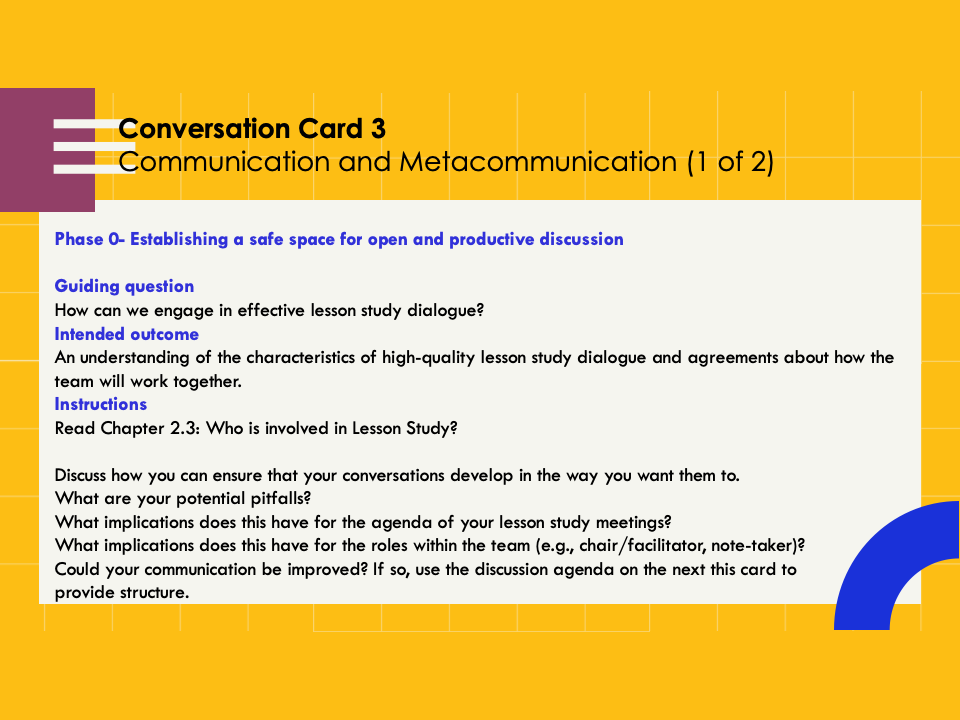
Read more on:

What is the purpose of the flipbook?

This document is intended to guide Teacher Educators (TEs) and Pre-Service Teachers (PSTs) in incorporating Lesson Study (LS) into Initial Teacher Education (ITE). In a context of teacher shortages across Europe, strengthening ITE quality in a sustainable way is critical: LS provides a collaborative framework that allows PSTs to grow professionally, develop their sense of self-efficacy and adapt their practice to focus on student learning.


The Lesson Study in Future Teacher Education (LIFT) project builds on experimented LS models to empower PSTs through meaningful partnerships, offering different resources to promote high-quality ITE.


The purpose of this flipbook is to support TEs in using LS in ITE programs for all school levels. It is addressed to TEs at teacher education institutions and to school-based mentors or cooperating teachers who collaborate with ITE. It will also be of interest to PSTs participating in lesson studies.


Learn more about the LIFT project from the project leader, Sui Lin Goei:

What is lesson study?

LS is a practice-based teacher education approach in which a group of participants – in ITE, PSTs and TEs – work together in preparing, enacting and reflecting on a lesson.


The activity begins with the LS group identifying a research question, often based on a common learning challenge observed among school students. The group then collaboratively formulates the aim of the lesson in relation to this question, using it to guide planning and reflection throughout the LS cycle. Then, the activity proceeds by carrying out a study of curriculum materials, professional and research papers and other documents that address such difficulty and perhaps making a close diagnostic of students’ knowledge and difficulties. Then, based on this, the participants do a detailed planning of a lesson. This lesson, called the research lesson, is enacted by a member of the group and observed by the remaining members. Finally, considering the aims of the lesson, the group reflects on the observed students’ learning and provides suggestions for improvement in the lesson plan and in the way the lesson was enacted.


This process typically spans six to eight working sessions, including the research lesson, and may require approximately 12 hours of collaborative work.


What is a lesson study, according to Stéphane Clivaz, a project member and the president of the World Association of Lesson Studies:

Why use lesson study in initial teacher education?

Lesson study as a system of learning

The LS process can be considered in a systemic way, as it creates a community of learning with different interrelated layers. The school students are learning during the research lesson, and they should know that the goal of the observation is to improve teaching and their learning so that they feel part of the community of learning.


Professional learning for teachers

The preservice or in-service teachers participating in the LS acquire professional knowledge about the effects of their teaching on students’ learning.

Literature in this field shows that this learning may take various forms:

  • better linking theory and practice
  • adopting a reflective and inquiry stance
  • developing collaborative skills
  • fostering teacher noticing
  • focusing on pupils and learning rather than on teaching
  • developing an attitude to anticipate pupils’ reasoning
  • deepening subject-matter knowledge and pedagogical content knowledge
  • improving teaching skills such as precise language use and time management


Impact on the education system

The process also helps TEs, researchers, textbook authors, and school administrators inquire into their own practice.


Moreover, joint participation in the process, even if it is only in an open research lesson and the discussion surrounding it, strengthens connections between the different parts of the education system.

What are the different ways to conduct lesson study in initial teacher education?

LS in ITE may be conducted in a variety of ways and with different PST groups. When PSTs are in their practicum, they may be working in isolation, in pairs, or small groups.


Sometimes, it is possible to join PSTs working individually or in pairs in a small group of three or four. A small group with three or four PSTs preparing a common research lesson is a very good organisation to carry out LS, but this may be adapted to other arrangements LS can also be used within existing courses (methods or didactics, for instance), giving the TEs as well as the students a new window to look at their professional thinking and pupils’ learning.


In that situation, depending on the number of students, one or more research lessons could be prepared and discussed. Adaptations are required, though, and a good knowledge of LS is needed from the educators.


The purpose of this flipbook is to help ITE stakeholders navigate the different possibilities and choose the best-fitting one to the context of the institution, while maintaining the fundamental characteristics and benefits of LS.

2 Key Ideas of Lesson Study in Initial Teacher Education


2.1 What are the Key Characteristics of Lesson Study?


As stated by Lewis (2002), Lesson Study (LS) is at the same time, very simple and very complex:


Lesson Study is a simple idea. If you want to improve instruction, what could be more obvious than collaborating with fellow teachers to plan, observe, and reflect on lessons? While it may be a simple idea, Lesson Study is a complex process, supported by collaborative goal setting, careful data collection on student learning, and protocols that enable productive discussion of difficult issues (pp. 1–2).


The essence of LS is in this process. Its primary purpose is not, in fact, to design a lesson: it is for the participants to learn about the impact of teaching decisions on student learning.


These five big ideas (Goei et al., 2021), can help you familiarize yourself with the key characteristics of LS:

In the case of PSTs, some adaptations from the more common in-service setting need to be made. This flipbook proposes several ways to do so in Chapter 3.

2.2 What is the Lesson Study Process like?


LS is often graphically represented as a cycle.

The LS process, with in-service or Pre-Service Teachers, may be described in the following way:


“In a Lesson Study, a group of teachers or a combined group of teachers and Teacher Educators/researchers work together, identifying the students’ difficulties on a given concept or issue, studying the related curriculum guidelines and research results, analysing tasks, and planning what they consider as a suitable lesson to address the proposed concept or issue. This “research lesson” is taught by a member of the group to a class of students, whereas the others observe the lesson with a focus on student learning. The participants seek to verify to what extent this lesson achieves the sought objectives and what difficulties arise. On the basis of this analysis, they may revise the lesson and re-teach it to another class […] Given the focus and the nature of the process, lesson studies may be regarded as a small investigation of the participants carried out on their own professional practice”

(Ponte, 2017, p. 169).

Identify issue in teaching and learning


At this stage, the group chooses a topic or an issue to focus on. This topic might be one that causes difficulty for students, is challenging to teach, one that PSTs want to get better at teaching. The topic can be disciplinary and/or cross-disciplinary focused. Before or at the start of the process, participants take time to get acquainted, clarify expectations, and agree on how they will collaborate as a group.


See an agenda template for the lesson study meeting


See how this stage is implemented in Portugal


You can use the conversation card below to guide discussion in this stage. See the complete set here. 

Study material and formulate research question


The study of materials and formulation of a research question is an essential but often overlooked stage. At this stage, the LS group analyses various resources in order to gain a deeper understanding of the initial issue. These resources may consist of official documents (national or school curricula), textbooks, texts from other LS, articles from professional journals, or other materials. At the end of this phase a research question is formulated.


See how this stage is implemented in Portugal


You can use the conversation card below to guide discussion in this stage. See the complete set here. 

Plan research lesson


The LS group plans a research lesson based on the research question and aligned with the larger unit. When planning the research lesson, key components include the flow of the lesson, the observation related to each moment of the lesson and the anticipation of students’ responses.


See a sample lesson plan


See how this stage is implemented in Portugal


You can use the conversation card below to guide discussion in this stage. See the complete set here. 


Lesson plan for a research lesson

Teach and observe lesson


A member from the LS group teaches the research lesson while other members purposefully observe according to the lesson-observation plan. Observers usually do not intervene during the lesson.


See a sample agenda for the pre-research lesson briefing meeting 


See a sample schedule for the research lesson day


See a sample of an observation form


See how this stage is implemented in Portugal


You can use the conversation card below to guide discussion in this stage. See the complete set here.


A member of the LS is teaching the research lesson
LS groups observing students’ notes after the research lesson

Reflect on lesson


The LS group shares their observations and discusses them in relation to the research question. As part of the reflection, the LS group plans modifications or changes to be implemented if the lesson is to be taught in the future. During this phase, an expert member, or koshi, might be present to help the group link theory to practice, highlighting new knowledge and fostering reflection on teaching and learning. In some cases, this expert is also present in the planning stage. If the expert is unavailable, the TE may assume this role.


See a set of reflection questions


See how this stage is implemented in Portugal


You can use the conversation card below to guide discussion in this stage. See the complete set here.

LS group discusses their observation using their field notes

Share Lesson Study report


Utilising the results of the entire LS process, the LS group synthesises their reflection to produce a LS report. This report will be stored as part of a knowledge base and shared with a wider community (other LS groups, department, school, district, university…).


See how this stage is implemented in Portugal


These stages are chronological. Nevertheless, reflections during one stage might lead to revisiting a previous one. For example, a moment of the planning phase might lead to refinement of a part of the study phase or even the research question.

The group may decide to plan a modified version of the research lesson, mainly to better answer the research question.

2.3 Who is involved in Lesson Study?


The implementation of LS in ITE requires the active involvement of various stakeholders, such as TEs, mentor teachers, and PSTs. These stakeholders contribute in different ways and may take on multiple roles throughout the LS process. In the subsequent section, we examine these roles and how stakeholders may assume different roles throughout the LS process. While the description provided here is general, please refer to the case studies and the LS variant table for nuances and examples.

Participants:

What are the core responsibilities?

Who can play this role?

  • Engage in LS without taking on additional roles.
  • Take responsibility for driving the LS process by raising questions and issues related to teaching and learning, in line with the teacher-led nature of LS.
  • Contribute actively to collaboration by creating a safe environment for sharing difficulties, ideas, and feedback, and by adopting a learner stance.

Pre-Service Teacher

  • PSTs commonly participate in LS within ITE contexts.
  • Participation offers opportunities to apply learning from previous courses and to practise key aspects of teaching in a more controlled environment than everyday classroom teaching.
  • At the same time, participation may present challenges related to increased responsibility and agency within the process.
Pre-Service Teachers in a post-lesson discussion

Facilitator:

What are the core responsibilities?

Who can play this role?

  • Safeguard the fundamental characteristics of LS by ensuring teacher agency and active collaboration throughout the process.
  • Guide the group through the LS agenda, ensuring that all phases are addressed and that the work progresses in a coherent and timely manner.
  • Actively elicit participation from all group members and monitor group norms to support inclusive and respectful collaboration.
  • Coordinate and organise the practical aspects of the LS process to ease participants’ engagement.
  • Support the quality of discussion by focusing the conversation, highlighting connections between contributions, and encouraging exploratory talk.
  • Create and maintain a safe environment in which participants feel able to share questions, uncertainties, and emerging ideas.


To get examples about what do facilitators do in each step of LS, you could read the case studies. 


See:

  1. How this stage is implemented in Portugal
  2. The variant table for detailed explanation
  3. A guide on facilitation in the Swiss setting

Teacher Educator

  • In ITE, TEs commonly act as facilitators of the LS process.
  • In this role, they typically design the overall LS process, prepare materials in advance, and plan and lead the working phases.
  • During sessions, they facilitate the work while maintaining a low profile, establishing a safe environment, encouraging broad participation, focusing discussion, and supporting exploratory talk.
  • TEs retain their responsibilities as TEs while also assuming facilitation responsibilities; differences in expertise and assessment roles may create power imbalances that can affect collaboration.
  • TEs may also take on the role of koshi (see below); when this occurs, the shift in role should be made explicit.


School-based mentor

  • Depending on the LS variant in ITE, school-based mentors may serve as facilitators (the same as way as TEs as described above), either independently or in collaboration with TEs.
  • Their teaching experience and knowledge of the class and individual pupils can be a distinctive asset in planning and reflecting on the research lesson.
  • Depending on the LS the variant, they may also teach the research lesson.
  • As with TEs, attention should be paid to potential power imbalances and their implications for authentic collaboration.


Pre-Service Teacher

  • In some LS variants in ITE, the facilitator role may be assumed by one PST or shared among PSTs in turn.
  • This may occur when the number of PSTs exceeds the availability of TEs or school-based mentors.
  • As PSTs may have limited experience with LS, additional support materials are important (e.g. conversation cards). For implementation examples, see Dutch Case Study.


Facilitator outlining key responsibilities during the LS process

Koshi:

What are the core responsibilities?

Who can play this role?

  • Draw on recognised teaching or subject-matter expertise and in-depth knowledge of LS to contribute expert perspectives to the LS process (a role often referred to in Japan as koshi, or “knowledgeable other” (see Takahashi & McDougal, 2016).
  • Support the LS group in making connections between theory and practice.
  • Help participants deepen their reflection on teaching and learning, particularly during post-lesson discussions.
  • Offer feedback that extends participants’ thinking while respecting their agency and ownership of the LS process.
  • Adapt the level and timing of contributions according to the LS model or variant (e.g. participation in planning, observation of the research lesson, or final commentary).
  • Make explicit when acting in the role of koshi, particularly when also holding other roles in the LS process.

Teacher Educator

  • TEs may act as koshi by contributing subject-matter, pedagogical, or LS-related expertise.

  • When doing so, they need to balance their own teaching agenda with responsiveness to the group’s research questions and learning needs.

  • It is important to make explicit when the TE is acting in the role of koshi, particularly when they also hold other roles in the LS process.


School-based mentor

  • School-based mentors may take on the role of koshi, providing expert feedback grounded in their teaching experience.

  • Their knowledge of the class and pupils can deepen reflection and support concrete connections between theory and practice.


Others

  • Depending on the LS model or variant, more than one koshi may be involved.

  • These may include teachers from the same school, school administrators, school leaders or other TEs who contribute additional perspectives, particularly during post-lesson discussions.

  • When multiple koshi are present, attention should be paid to ensuring coherence and complementarity in feedback.


Koshi in a post-lesson discussion

3. Models and Variants of Lesson Study in Initial Teacher Education


3.1 How do different Lesson Study models work in practice?


In the table below, we present three principal models of LS that are adaptable for ITE programmes. The selection of a particular model may be informed by various contextual factors, including the cohort size of PSTs, the availability and expertise of TEs and school-based mentors, and the alignment of teaching practicums and placements within the same schools.


By offering these diverse models, we aim to provide TEs with practical frameworks and insights that can facilitate the integration of LS within their own institutional settings.


To support this selection process, we have included a decision tree to help you explore which model and variant might suit your particular context. Please use the decision tree as a starting point for reflection, not a definitive or prescriptive guide.


decision tree


The details for each variant are also presented in the Variant Table. To clarify the roles of stakeholders — PSTs, TEs, and school-based mentors — within each variant, we have outlined their specific responsibilities across each stage of the LS cycle that we presented in Section 2.2 (Study, Plan, Teach/Observe, Reflect).

3.1.1 University-centred Lesson Study


(a) Peer-Microteaching LS

Peer-Microteaching LS involves PSTs completing the entire LS cycle at the university level, with peers acting as their “students”. This approach is typically integrated into ITE courses, allowing PSTs to first gain exposure to LS through lectures and coursework before engaging in Peer-Microteaching LS. In this process, PSTs often work in small groups of three to six to plan lessons, receive feedback from TEs and revise their plans collaboratively. The planned lessons are then taught to their peers within the cohort, with observations and feedback provided by TEs and colleagues.


(b) University-Hosted LS

This variant of LS engages PSTs in collaboratively planning a research lesson and implementing it with school students in a university setting. The cycle incorporates a needs-assessment phase in which PSTs interact directly with school students via video calls or face-to-face meetings to gather insights into their interests and needs. The school students are subsequently invited to the university, where the collaboratively designed lesson is conducted, allowing PSTs to apply their planning in an instructional context informed by the learners’ input.

Lesson study team in a post-lesson discussion

3.1.2 Practicum-centred Lesson Study


(a) Independent Practicum LS

In the practicum-centred model, this variant of LS emphasises the autonomy of PSTs by removing the requirement for a school-based mentor during their practicum. Instead, PSTs form pairs and take full responsibility for the LS cycle, from planning and implementation to observation and reflection. Working collaboratively, each pair designs and teaches a lesson while the partner observes, followed by joint reflection to discuss evidence of student learning and areas for improvement. This peer-driven process nurtures professional independence, encourages critical dialogue, and strengthens PSTs’ capacity to give and receive constructive feedback. It also allows them to experience LS as a self-sustained, flexible model adaptable to diverse practicum contexts.


(b) Teacher-Educator-Supported Practicum LS

This variant of LS centres on strong support from TEs during the practicum phase. In this model, TEs guide PSTs through each stage of the LS cycle, offering subject-matter expertise, pedagogical insights, and alternative perspectives. Acting as advisors rather than supervisors, TEs are invited by PST groups to contribute ideas, attend the research lessons, and participate actively in post-lesson discussions. This collaborative structure positions the TEs as facilitators of reflective dialogue and professional growth, helping PSTs connect theory with classroom practice while maintaining ownership of their learning process.


(c) Mentor-Supported Practicum LS

This approach focuses on providing PSTs with authentic classroom experiences in a school setting during their teaching practicum. It typically involves PSTs collaborating with school-based mentors and TEs to implement the LS process. In this approach, PSTs, TEs and school-based mentors often work together to plan lessons, with mentors sometimes teaching the initial lesson. Feedback and reflections are used to identify challenges and make improvements, after which PSTs reteach the lesson to apply these refinements. Collaborative observation and post-lesson discussions are integral to this process, often involving school-based mentors, TEs and peers.

3.1.3 Hybrid Lesson Study


(a) University-School Hybrid LS

This variant of LS integrates two stages of teaching to scaffold PSTs’ learning. In the first stage, PSTs conduct peer micro-teaching sessions, treating their peers as students to test and refine their lesson plans in a safe, low-stakes environment. TEs and peers provide targeted feedback after each session, enabling PSTs to revise and improve their lesson plans through one or more cycles of reflection and adjustment. In the second stage, the revised lessons are implemented in real classroom settings with school students. This progression from peer micro-teaching to authentic teaching supports PSTs in developing confidence, pedagogical skills, and adaptive lesson design practices, while also allowing TEs to align course instruction with PSTs’ observed needs.


(b) School Hybrid LS

PSTs are introduced to the LS process as part of the ITE course. They collaboratively plan lessons at the university and then teach the research lesson in a school setting with school students. Since the lesson is conducted in the field, in-service teachers often participate by observing the research lesson and contributing to post-lesson discussions. In some cases, the lesson is taught by an in-service teacher.


Case Study: Portugal


(c) School-University Hybrid LS

This variant involves PSTs collaboratively planning the research lesson at the university, teaching it in a real classroom with school students, and then revising and reteaching it to their peers at the university. The reteaching phase focuses on addressing student interactions and questions from the school-based research lesson, while also providing an opportunity for PSTs to share their reflections and teaching strategies with classmates.

4. Going into Practice

4.1 How can your context shape the way you do Lesson Study?


Given the wide range of Lesson Study (LS) variants in Initial teacher Education (ITE), we have included a decision tree to support the selection of a contextually appropriate variant. It considers factors such as the location of LS implementation and involvement level of stakeholders, though these are only some of the many considerations that may arise in practice. This section highlights additional considerations that can shape how LS works in your setting. These factors, drawn from varied research contexts, provide insights into conditions, resources, and adaptations that can shape the design and effectiveness of different LS variants.


4.1.1 Time allocation for Lesson Study


This includes practical considerations such as the overall timeline of the cycle, the number of meetings scheduled, and the duration of each meeting. These elements can significantly affect how deeply participants can engage in planning, observation, and reflection, and may need to be adjusted to align with institutional schedules or participant availability.


4.1.2 Group size


The number of participants in a LS group is influenced by various factors, some of which may conflict with one another. One of the main factors is institutional constraints, which pertain to the conditions within the institution where the LS is to be conducted. This includes considerations such as the number of Pre-Service Teachers (PSTs), the PST/Teacher Educator (TE) ratio, and the availability of school-based mentors and classes. These constraints can sometimes conflict with the need to encourage active participation and collaboration among group members as much as possible.


Other factors to consider include the previous experience of group members with LS and the level of comfort among them. From this perspective, these factors can impact the autonomy of participants. If members are already familiar with the structure and dynamics of LS, they are likely to be more autonomous. Consequently, the TE may be able to support more groups, allowing for smaller group sizes.

Therefore, the number of participants in each group must be carefully considered, but there is no definitive “right” number. Based on our experience and the existing literature, we recommend forming groups consisting of two to five PSTs, with a maximum of six, if possible.


4.1.3 Presence of educators


This may include a facilitator, who guides discussions, maintains focus, and ensures progress through each phase, or a koshi (knowledgeable other) who provides subject-matter expertise. The presence of either depends on availability, and in some cases, one person may serve in both roles. It is therefore essential to define these roles clearly, even when they are performed by the same individual.

4.1.4 Presence of other Pre-Service Teachers


When multiple PSTs are placed at the same practicum school, it creates a shared teaching environment that supports collaboration, peer observation, and joint reflection. Working in similar classroom contexts allows PSTs to co-plan lessons more easily, observe each other’s teaching in real time, and reflect on comparable student interactions. This factor also expands the range of feasible LS variants. For example, it makes it possible to form a LS group within the same school, enabling more active involvement from school-based mentors. It also supports a more concentrated, practicum-centred LS model, rather than relying on hybrid arrangements that span both university and school settings.


4.1.5 Phase of Initial Teacher Education where Lesson Study is implemented.


The phase of ITE in which LS is implemented is also a factor to consider.  LS can take place at different points in the programme, at the beginning, before the teaching practicum, or during the practicum itself, and each timing serves a distinct purpose. When introduced early, it can help PSTs to build foundational collaboration and inquiry skills; when positioned before the practicum, it allows them to test and refine lesson planning in a low-stakes environment; and when integrated during the practicum, it supports direct application of learning in authentic classroom contexts. The chosen phase, therefore, shapes both the focus and depth of the LS experience.


4.1.6 Grading/Evaluation of the LS project


Another contextual factor is the grading or evaluation of the LS project. In some programmes, LS is formally graded, while in others it functions as a formative, non-assessed activity. These different approaches can influence how PSTs engage with the LS process and what aspects of their work are made visible, such as planning, collaboration, teaching, or reflection, as well as the timing of any evaluation.

Across contexts, TEs make different choices about how to approach evaluation in ways that align with their programme goals. For example, some prefer broad forms of recognition, such as pass/fail decisions, rather than detailed numerical grades. Others focus evaluation not on the individual PST but on process-oriented elements of the LS experience, including the quality of reflection, collaborative work, or engagement with inquiry.


There are also programmes in which reflection reports are read after any formal evaluation, with the intention of encouraging PSTs to write openly about their learning rather than shaping their reflections to meet perceived assessment expectations. In addition, some contexts make use of portfolios to document learning across the LS cycle, allowing multiple forms of evidence to be brought together over time.


However, in all cases, the teaching performance of a PST teaching the research lesson should not be evaluated.


4.2 Lesson Study project across Europe


Though this flipbook focuses on LS in ITE, many excellent resources have been developed to guide In-Service Teachers (ISTs) which may be of interest to readers.


Three examples are included here:


  1. A guide on facilitation in the Swiss setting

    (Hoznour et al., 2024). 


  2. A guide for ISTs in the Irish setting

    (Owens et al., 2023).


  3. A guide for ISTs in the European context
    with a focus on reasoning in mathematics (Barbier et al., 2023).

4.3 How can ethical, respectful and safe practices be ensured in Lesson Study?


4.3.1 Establishing a safe space for open and productive discussion


Before the LS, it is essential to establish a safe space for open and productive discussions. This requires a comprehensive and inclusive strategy to create a secure learning environment for all participants. It involves proactive measures to reach an agreement and consensus on collaboration methods, emphasising respectful communication and the involvement of all stakeholders. This approach ensures a supportive atmosphere for every participant in the LS and every learner. The following conversation cards may prove useful.

You can find a text version for easy copy and paste, along with the full card set, here.


4.3.2 When observing students in the research lesson


Before the research lesson, a member of the LS team should explain the process to the students in the lesson. An essential part of this is the clarification that the focus of the observers is on students’ learning and not an evaluation of their performance.


During the research lesson, the observers note anything about the student(s) that may inform the research question. In general, observers do not interfere with the lesson itself. This can often be challenging for observers, especially for members of the LS team. For this reason, developing observation protocols may be beneficial.

4.3.3 Storing collected data in a safe space


In a LS, a substantial amount of information and data is typically gathered. The research lesson design includes a section in the LS plan that outlines the data collection methods, such as how observations will be conducted, which students will be interviewed, which student work will be utilised, what artefacts will be collected, and what additional information is necessary to address the research question.


This section also details how observations are recorded via audio and video, and whether active consent is required from the participating students and, if they are minors, from their parents or guardians, especially if this is not covered by the school’s data management plan.


During the preparation phase of the LS, it is also advisable to discuss where all developed artefacts, collected data, and information will be stored, such as on a shared drive like a Teams environment, SURF, One Drive, or a secure server like Research Drive, for the duration of the LS.


This information should be explicitly stated in the consent form, including where the data will be stored and how it will be used. The data collected in this study are confidential and largely context-specific. These data must be stored on a secure server for the duration of the LS. The team needs to discuss who will have access to the data, who will have restricted access, and when the data will be deleted after use.

Conversation cards

The conversation cards are practical tools for structuring dialogue within the Lesson Study team during the different stages of the Lesson Study process. Instead of slipping into general evaluations (e.g. “the lesson went well”), these cards shift the focus to students’ learning processes and behaviour. Each card provides guiding questions, prompts, and activities to help teams discuss and work through a particular aspect of the process.

The conversation cards used in the LIFT flipbook are adapted from the “gesprekskaarten” in Basisboek Lesson Study in de lerarenopleiding [A Handbook of Lesson Study for Initial Teacher Education] (De Vries, Goei, & Verhoef, 2023). They were originally developed by Carien Bakker (Bakker et al., 2022) for initial teacher training at the University of Groningen.

These cards have been translated, adapted, and reorganised to align with the five stages of the LIFT Lesson Study process presented in the flipbook.

Conversation Card 1 – Getting to Know Each Other and Discussing Expectations

1 of 2

Phase
0- Establishing a safe space for open and productive discussion
Guiding questions
• Who are we?
• What are our expectations for the lesson study process?
Intended outcome
Establish a foundation for effective collaboration.
Instructions
Read Chapter 2: Key Ideas of Lesson Study in Initial Teacher Education
Getting to know each other:
Each participant brings something they are enthusiastic about and shares it with the group. This could be, for example, a recent lesson they taught that they are proud of, an interesting article or engaging blog post they have recently read, or a student product they are enthusiastic about.
Expectations:
First, answer the questions on the next card individually. Then share and discuss your answers with the other members of your lesson study team.

2 of 2

What are my expectations?

  • What do you expect from this lesson study process?
  • What would you like to learn through participating in lesson study?
  • When will you consider this lesson study process successful?

Conversation Card 2 – Preparing for Effective Collaboration

1 of 2

Phase
0- Establishing a safe space for open and productive discussion
Guiding question
How can we work together in a way that enables us to learn from the process and from each other?
Intended outcome
The team has established agreements about how it will work together.
Instructions
Read 1: Introduction: What is lesson study?
First, respond individually to the statements and questions on the next card.
Then, share and discuss your responses with the other members of your lesson study team. Together, develop a protocol to avoid potential pitfalls and establish an effective lesson study team.
Elements to include in the protocol:

  • What do we each consider important to do—and not to do—in our collaboration?
  • How will we address difficulties or problems that arise in our collaboration?
  • What is important in our interactions during lesson study meetings to ensure the quality of our discussions?
  • What agreements will we make about confidentiality and the information discussed within the team?
  • At which points during the lesson study cycle will we evaluate our collaboration?

2 of 2

Reflecting on My Contribution to the Collaboration


  1. As I begin investigating student learning through lesson study, I am concerned about …, but I am particularly looking forward to ….
  2. I think I bring the following quality/qualities to the team that will contribute to conducting a successful lesson study: ….
  3. When I reflect on my own qualities as an inquiring teacher, I see the following potential pitfall in my participation in lesson study: ….
  4. It is important for my team members to know that ….
  5. I hope that my lesson study team members bring the following qualities to the team: ….
  6. Lesson study presents me with the following challenges: ….
  7. I would be a suitable chair/facilitator, note-taker, timekeeper, or other role: ….
  8. At the end of this lesson study, I will be satisfied if ….
  9. I would like us to make the following agreements about planning, communication, and support throughout this lesson study: ….

Conversation Card 3 – Communication and Metacommunication

1 of 2

Phase
0- Establishing a safe space for open and productive discussion
Guiding question
How can we engage in effective lesson study dialogue?
Intended outcome
An understanding of the characteristics of high-quality lesson study dialogue and agreements about how the team will work together.
Instructions
Read Chapter 2.3: Who is involved in Lesson Study?
Discuss how you can ensure that your conversations develop in the way you want them to.

  • What are your potential pitfalls?
  • What implications does this have for the agenda of your lesson study meetings?
  • What implications does this have for the roles within the team (e.g., chair/facilitator, note-taker)?
  • Could your communication be improved? If so, use the discussion agenda on the next card to provide structure.

2 of 2

If you want to consciously improve your communication—and thereby strengthen your collective learning process—metacommunication may be necessary: communicating about how you communicate.
The discussion agenda below can be used to structure this metacommunication.


Activity When Questions

Planning

At the beginning of each meeting

• What content-related goals do you have for this discussion?
• What are the procedures for this meeting?

• What aspects of your interaction are important to consider?
• Are there any feelings or concerns from a previous meeting that need to be taken into account? If so, how?


Doing

During each meeting


Evaluation

At the end of each meeting

• How did things go with:
– the content-related goals?
– the procedure
– the interaction?
– feelings or concerns?

Action

At the end of each meeting

• What will you do differently regarding your communication at the next meeting?

Conversation Card 4 – Orienting to the Research Question

1 of 2

Phase 
1 – Identify issue in teaching and learning 
Guiding question 
Which research question will we choose? 
Intended outcome 
An initial orientation to the research question 
Instructions 
If a lesson study team has already been formed: 
First, respond individually to the statements and questions on the next card. 
Then, share and discuss your responses with the other members of your lesson study team and select a suitable topic for your lesson study. 
If a lesson study team has not yet been formed: 
First, respond individually to the statements and questions on the next card. 
Then, take part in a speed-dating activity and have a three-minute conversation with each of your fellow students. 
Form lesson study teams based on shared interests. Then, continue with Conversation Card 1. 
 

2 of 2

Exploring Possible Research Question 

  1. Which topic have you found most difficult to explain so far? What made it difficult?
  2. Which topics are you particularly enthusiastic about? Which topics make you break out in a “cold sweat”?
  3. Which topics do you feel most confident teaching? Which do you feel least confident teaching?
  4. Which topics have students found most difficult so far? Which have they found least difficult? What did you notice that indicated this?
  5. Which topics have students been particularly motivated to learn? Which have they been less motivated to learn? What did you notice that indicated this?
  6. Which topics are included in the curriculum for your classes around the time when you will conduct the research lesson? What do students typically find difficult about these topics?
  7. Are there any new topics in the curriculum, new teaching approaches, or new learning materials that you would like to try out?
  8. Are there any topics or ideas from the literature or theory that you would like to explore in your lesson study?
  9. Complete the following sentence: 
    If I could get an answer to the following question about student learning, I would consider this lesson study worthwhile: 
    ………………………………………………………………………… 
     

Conversation Card 5 – Exploring the Research Question

1 of 2

Phase 
2 – Study material and formulate research question 
Guiding questions 

  • What research question related to student learning do we want to address?
  • What is the scope of the research question?
  • Why is it important to address this research question?
  • Can the research question be addressed in a single research lesson?

Intended outcome 

  • A precise definition of the research question to be addressed.
  • A description of the nature and scope of the research question you want to address. Discussion Conversation Card 7 explores the research question in greater depth. 

Instructions 
The questions on the next card are intended to guide your thinking. 
To answer these questions, you will need to engage with the relevant literature. 
You will notice that your thinking may diverge at this stage, that the research question may actually consist of several related aspects, and that you may sometimes start thinking about solutions too quickly, before the research question has been clearly defined. This is perfectly fine. At this stage, however, your main task is to formulate the research question as clearly as possible. 
Only once you have a clear understanding of the research question you want to address can you move on to the next stage. 
 

2 of 2

Reflection Questions 

  1. Is your research question related to students’ knowledge, skills, or attitudes? What is its relationship to the attainment targets, core objectives, or your personal vision of good education?
  2. How significant is the research question? Do all students experience this difficulty? Which students do, and which do not?
  3. Is the research question important enough to address? What will students miss or experience if the research focus is not addressed?
  4. Is the research question sufficiently focused to be addressed in a single research lesson? 

Ideas for exploratory preliminary investigations 

  • Use a questionnaire or exit ticket for the whole class, for example via Google Forms, asking students how they usually approach a particular task, how difficult they find the task, and in which situations they find it difficult to approach the task.
  • Ask several students to think aloud while carrying out a task.
  • Analyse a completed homework assignment or test.
  • Ask students to formulate questions about the learning content. 

Note: Students generally find it interesting to participate in research, so do not hesitate to ask for volunteers. 
 

Conversation Card 6 – Possible Explanations for the Research Question

1 of 2

Phase 
2 – Study material and formulate research question 
Necessary prior knowledge 
The nature and scope of the research question are clear. 
Guiding question 
What explanations can we develop for why the research question has emerged? 
Intended outcome 
A range of possible explanations, considered from multiple perspectives. 
Instructions 

  1. Study the example on the next card, in which explanations for a difficulty in student learning are explored from different perspectives.
  2. Based on your own experiences, those of the teacher educators or school-based mentors, preliminary investigations with students, and relevant research literature, formulate possible explanations for your research focus. Try to consider multiple perspectives. The more perspectives you explore, the richer your understanding will be.
  3. Share and discuss your ideas. Identify what you need to find out more about and how you will investigate this further. 
     

2 of 2

Example 
The research question is that students find it difficult to formulate and justify their own appropriate interpretation of an ambiguous literary story. We think that students may find it particularly difficult that there is no single, clearly correct answer, as well as analysing a literary text for ambiguous aspects related to the way the story is narrated. One possible explanation is that students of this age (14 years) may not yet be sufficiently aware of the literary mechanisms at work in a story and of how these mechanisms can influence their reading experience and interpretations. 
In the reading comprehension instruction students have received so far, they have mainly been encouraged to read selectively in order to identify the correct answer to a question. In addition, our subject departments tend to prioritise reliability over validity when designing assessments. As a result, questions that require students to develop their own interpretation occur relatively rarely—not only in literature, but also in other subject areas. 
Another possible explanation is that the teaching materials students use contain few tasks that require them to develop their own interpretation. Moreover, when narrative perspective is addressed in the teaching materials, there is little attention to the function and effects of the narrative perspectives used by the author. 
Perspectives to consider: 

  • Student learning
  • Teaching and assessment
  • Teaching materials and learning content 
     

Conversation Card 7 – Reasoning During Lesson Study

1 of 5

Phase 
2 – Study material and formulate research question 
Guiding questions 

  • How do you reason during Lesson Study?
  • What does a good research question look like? 

Intended outcome 
An initial understanding of the reasoning underlying a Lesson Study and of the characteristics and structure of a well-formulated research question. 
Instructions 
Study the explanation and examples of the underlying reasoning used in Lesson Study and the formulation of the research question provided on the following cards. 
Keep the underlying reasoning and research question in mind throughout each meeting. This will help you maintain focus. 
Tip: Create a mind map showing all the elements of the reasoning. Keep it with you during each meeting and add to or revise it as needed. 
 

2 of 5

Underlying reasoning based on what students find difficult 
If you know that students find certain things difficult to learn, you first need to gain insight into exactly what they find difficult, why they find it difficult, and how you can support them in their learning. The underlying reasoning in Lesson Study can be summarised as follows. Steps A–D take place before the research lesson, while steps E–G take place afterwards.* 
 Steps and underlying reasoning 
Step A 
The problem students experience in relation to learning … is …. 
Step B 
We consider it important to address this problem because …. 
Step C
The problem may be caused by …. 
Step D
The research lesson designed to address the problem is based on the following design principles: …. 
Step E
The research lesson has / has not / has partly addressed the problem. 
Step F
We can explain this by …. 
Step G 
A subsequent research lesson should therefore be based on the following design principles: …. 


All elements of this underlying reasoning need to be substantiated: 

  • How do you know that this is a problem?
  • How do you know what is causing it?
  • Why have you chosen these design principles rather than others?
  • How do you know whether the research lesson has worked, has not worked, or has worked partly?
  • And so on. 

This substantiation can come from the literature, from your own observations (for example, through an analysis of a diagnostic assessment and interviews with students), and from your own and others’ experiences, such as successful experiences with implementing a particular teaching approach or activity. 


Based on Bakker et al. (2022). 
 

3 of 5

Example of underlying reasoning and a research question 
A: When our students select books for their reading list, they often base their choice on the length of the book and recommendations from others. As a result, students regularly choose a book that is not at an appropriate level for them or does not match their interests. If this happens too often, they may become less motivated to read and read less as a result. 
B: Subject-specific research shows that it is important to pay attention to book selection because the amount of reading students do is an important predictor of their educational attainment. Limited reading motivation can contribute to low literacy levels and a negative cycle of declining reading engagement. 
C: The problem of students choosing inappropriate books may be caused by their having insufficient knowledge of appropriate book-selection strategies, such as those described in the subject-specific literature. The learning objective of the research lesson is: students use a book-selection strategy when choosing a book to read. 
D: Our research lesson is based on the following design principles: 

  • Students become familiar with potentially suitable books through the activity “Book Speed Dating.”
  • Students receive an explanation of the strategy for selecting an appropriate book.
  • Students engage in reflective conversations with their peers about the excerpts they have read and their book-selection process. 

The final research question is: 
How do students select an appropriate (new) book during a lesson based on book speed dating, a new book-selection strategy, and social interaction? 
Sub-questions 

  1. What is the student’s initial attitude towards reading, and how does the student select a book before the lesson?
  2. Which elements of the strategy do students use?
  3. Which elements of the strategy do students consider relevant?
  4. To what extent do students arrive at a book choice during the lesson?
  5. To what extent can students justify whether their choice of a particular book is appropriate?
  6. To what extent do students use their reading level when choosing a book?
  7. What is the learning outcome of the lessons for the student? 
     

4 of 5

Underlying reasoning based on an ambition to introduce something new 
Even when you want to try out something new—for example, a new teaching approach, activity, or set of teaching materials—you can assume that this innovation has emerged from a need to address a learning problem experienced by students. In this case, you reason backwards from the proposed solution (D) to the problem, to what students find difficult, and to why they find it difficult. 
The underlying reasoning based on such an ambition can be summarised as follows. Steps A–D take place before the research lesson, while steps E–G take place afterwards.  
Steps and underlying reasoning 
Step A 
We have chosen to try out the following … because it may help address the following problem in student learning: …. 
Step B 
We consider it important to address this problem because …. 
Step C
The problem may be caused by …. 
Step D 
To implement our ambition and address the problem, our research lesson is based on the following design principles: …. 
Step E
The research lesson has / has not / has partly achieved the intended ambition. 
Step F
We can explain this by …. 
Step G 
A subsequent research lesson should therefore be based on the following design principles: …. 
All elements of this underlying reasoning need to be substantiated: 

  • What exactly is the ambition?
  • How do you know that this ambition can help address the problem?
  • What is causing the problem?
  • Why have you chosen these design principles rather than others?
  • How do you know whether the research lesson has worked, has not worked, or has worked partly
  • And so on. 

This substantiation can come from the literature, from your own observations (for example, through an analysis of a diagnostic assessment and interviews with students), and from your own and others’ experiences, such as successful experiences with implementing a particular teaching approach or activity. 

5 of 5

Example of underlying reasoning and a research question 
A: Various sources indicate that the Teaching Through Problem-Solving (TTP)  approach used in Japan can contribute to strengthening students’ Problem-Solving Skills (PSS). Our students tend to stop thinking quickly when they encounter tasks for which they cannot immediately see a solution. PSS could support students in searching for knowledge that they can use to solve the task. PSS includes the use of mathematical heuristics, metacognitive skills, and a productive disposition towards problem solving. We have therefore chosen to use the TTP approach to support students in strengthening their PSS. 
B: We consider PSS important because these skills can help students when they do not immediately see an appropriate approach to a task. Higher-order questions in tests often require students to discover for themselves which approach is needed. In examinations, too, many marks can be earned on tasks that require problem-solving skills. 
C: The problem may be caused by students having too little practice with tasks for which the solution method is not immediately apparent. Many students also lack the appropriate disposition for tackling problems. In addition, solving mathematical problems requires metacognitive skills. These receive little attention in mathematics lessons. 
D: Our research lesson is based on the following design principles:

  • Students first work individually on a starting task that can be solved using techniques introduced previously. The starting task can be solved in multiple ways.
  • Interactive whole-class discussion: students articulate their solution methods and are also expected to explain relevant solution methods used by other students.
  • During the whole-class discussion and the lesson summary, explicit attention is paid to problem-solving skills, metacognitive skills, and students’ dispositions towards working on a problem. 

The final research question is: 
How do students use problem-solving skills in a lesson based on the TTP approach? 
Sub-questions 

  1. Which problem-solving skills (heuristics, metacognition, disposition) are visible when students work on the starting task?
  2. Which problem-solving skills (heuristics, metacognition, disposition) are visible during the whole-class discussion?
  3. How are problem-solving skills made explicit during the whole-class discussion and in the lesson summary?
  4. To what extent do students perceive the lesson as contributing to their problem-solving skills? 
     

Conversation Card 8 – Learning Objectives and Content

1 of 2

Phase 
3 – Plan research lesson 
Necessary prior knowledge 
The nature and scope of the research focus and the possible explanations for it are clear. 
Guiding questions 

  • Which learning objectives do we want to achieve through the research lesson?
  • Which content needs to be addressed in the research lesson for students to achieve these learning objectives? 

Intended outcome 

A clear and comprehensive understanding of the learning objectives and the corresponding content, informed by relevant literature and educational practice (teaching materials, colleagues’ experiences, and students’ experiences). 
Instructions 
Answer the questions on the next card.  
 

2 of 2

Reflection Questions 

  1. What are your learning objectives? Do they concern skills, knowledge, or attitudes?
  2. How do the objectives relate to the progression of learning and the final attainment targets?
  3. What knowledge do students need in order to achieve the learning objective? Consider facts, concepts, strategies, or metacognitive knowledge. See also the framework below.
  4. Provide precise definitions and descriptions of the concepts and strategies by studying relevant literature, teaching materials, and textbooks.
  5. Describe what you would consider a successful outcome at the end of the research lesson. In that case: 

a. the student does … and does not … 
b. the student thinks … and does not … 
c. the student says … and does not … 
d. the student feels … and does not … 
Now formulate the learning objectives and content very precisely, using student-friendly language. 

Types of Knowledge 

Type of knowledge Description Example
 Facts   Refer to objects, events, or people. They are verifiable, although they are not necessarily true.   Knowing that “children” is the plural form of “child”. 
Concepts  Definitions or descriptions of ‘parts of reality’. The subject of a sentence is the person, thing, or entity that performs the action or is described in the sentence. 
Rules or principles  Ways of connecting particular concepts or facts in specific ways, enabling phenomena to be explained or predicted.  In the simple present tense, a third-person singular subject generally takes a verb ending in -s or -es. 
Procedures or strategies  Knowing what to do in a particular situation and which techniques or methods to apply. To form the past tense of a regular verb, add -ed to the base form of the verb.
Metacognitive knowledge  Knowledge of oneself, including awareness of the possibilities and limitations of one’s own cognitive abilities. I often forget to add -s to verbs when writing in the simple present tense, especially when I am writing quickly. 

Conversation Card 9 – Analysing the Selected Content

1 of 2

Phase 
3- Plan research lesson 
Necessary prior knowledge 
You have a clear understanding of what the content of the research lesson entails. In this card, you will explore what students may find difficult about this content. Based on your analysis, you may decide to further refine the learning objectives and content. 
Guiding questions 

  • What are students likely to find difficult when learning this content? Why?
  • What implications does our analysis have for the design of the research lesson? 

Intended outcome 
You understand what students may find difficult about the content you have selected and can use this understanding to make better-informed decisions about how to teach this content. 
Instructions 
Create an overview of questions that can provide insight into what students may find difficult about the content. Leave half an A4 page for each question to record your answers. 
Start by answering one question and, after one minute, pass it on to the next person. Continue until all questions have been addressed. 
The next card provides questions for ideas.  

2 of 2

Reflection Questions 

  1. Complete the following sentence: 
    If I were student X (a student from my own class) and this content were presented to me, my first reaction would be …
  2. Students may find the following aspects of the content difficult: …
  3. And they may not find the following aspects difficult: …
  4. Students may have the following misconceptions: …
  5. If a student does not understand the content, we can tell by …
  6. And if a student does understand it, we can tell by …
  7. We can explain the difficulties students are likely to experience with this content by …
  8. As a teacher, I can gain insight into what is happening in a student’s mind while learning this content by … 

What implications do your answers to questions 1–8 have for the design of the research lesson? 
 

Conversation Card 10 – Teacher and Student Activities

1 of 2

Phase 
3- Plan research lesson 
Necessary prior knowledge 
The learning objectives and content have been clearly described. 
Guiding question 
What teacher and student activities might be effective? 
Intended outcome 
All design principles for the research lesson have been identified, together with the underlying reasoning. 
If you want to design intervention X, with the aim of achieving Y and Z, it is advisable to give the intervention characteristics A, B, and C (Van den Akker, 1999)
Characteristics A, B, and C are the design principles. 
Instructions 
Based on a study of relevant literature, discussions with the subject coach or other experienced colleagues, and the sentence starters for formulating design principles on Discussion Card 10 (2 of 2), formulate potentially suitable teacher and student activities and discuss them critically. 
Together, weigh the alternatives and select the most appropriate activities. 
Then formulate your underlying reasoning and research question. 
 

2 of 2

Sentence Starters for Formulating Design Principles 
Adapted from: Pameijer et al. (2009). 
To achieve the learning objective, this student needs: 
An explanation that… 
✔ is brief and clear 
✔ is extended, with the teacher modelling the process and thinking aloud 
✔ provides the solution strategy step by step 
✔ makes use of the student’s strong visual abilities 
✔ is primarily auditory 
✔ clarifies the meaning of concepts 
✔ activates the student’s prior knowledge and makes connections with the new content 
✔ encourages the student to participate and think along 
✔ encourages the student to develop their own solutions 
✔ supports the student in planning their own work 
Tasks that… 
✔ are at or just below the student’s level, so that the student can experience success 
✔ are just above the student’s level, so that the student experiences cognitive challenge 
✔ provide additional learning and practice opportunities 
✔ connect with the student’s lived experience and/or current events 
✔ are concise and contain as few distractions as possible 
✔ provide the student with ample space to work independently 
✔ include worked examples 
Peers who… 
✔ are willing to work with the student 
✔ are willing to help the student with difficult or complex tasks 
✔ accept the student and understand that they may need to approach certain situations differently 
✔ invite the student to participate outside lessons 
✔ ignore the student’s behaviour and do not laugh at them 
✔ do not challenge or provoke the student 
A learning environment that… 
✔ is clear and well structured 
✔ challenges and activates the student 
✔ encourages the student to take their own initiative 
✔ has clear rules and routines 
✔ provides a calm learning environment 
Teachers who… 
✔ provide additional or extended explanations 
✔ provide appropriate feedback 
✔ help the student learn to attribute success to their own abilities and effort 
✔ model an approach while thinking aloud 
✔ allow room for the student’s own initiative 
✔ give the student ownership of their learning process 
 

Conversation Card 11 – Developing the Research Lesson in Detail

1 of 2

Phase 
3 – Plan research lesson 
Necessary prior knowledge 
You have reached agreement on the design principles. 
Guiding questions 

  • What does the research lesson look like in detail? (learning objectives, content, and implementation of the design principles through teacher and student activities)
  • Is the lesson sufficiently transferable? Is every team member able to teach the research lesson exactly as intended? And could someone who is relatively unfamiliar with the lesson teach it as intended? 

Intended outcome 
A feasible research lesson. 
Instructions 
Develop the lesson based on your design principles. In doing so, discuss the requirements outlined on the next card.  
Present the lesson design to someone from outside the team (e.g., a coach, subject-specific teacher educator, or fellow student). Formulate a clear question about an aspect of the design you would like feedback on, and discuss the outcomes with the team. 
 

2 of 2

Requirements for the Research Lesson 
To observe students’ learning effectively during the lesson, consider how you will gain insight into how they are trying to master the content. For example, students can be given tasks that require them to verbalise how they solve a problem, ask questions of each other or the teacher, or create a mind map showing how they connect important concepts. 
The lesson should therefore include activities that enable observers to gain insight into how students think and learn during the lesson. 

  1. Have all design principles been adequately incorporated into the lesson?
  2. At which points in the lesson is student learning made visible? Do these moments provide sufficient opportunities to collect data?
  3. What specific demands do these moments place on the teacher delivering the lesson?
  4. Is the lesson described in sufficient detail for someone who is relatively unfamiliar with it to teach it? 

Carefully designing observation forms and interview questions to subsequently ‘measure’ this learning is also an important part of lesson study. This is addressed in Conversation Cards 13 (Observing) and 14 (Interviewing). 
 

Conversation Card 12 – Selecting Case Students

1 of 3

Phase 
3 – Plan research lesson 
Necessary prior knowledge 
The research lesson has been developed in detail. 
Guiding questions 
Which students will we select for observation and interviews, and why these students? What characterises these students? 
Intended outcome 
A well-considered selection of case students to be observed and interviewed. 
Instructions 
Select a number of students to be studied during the research lesson. 
Describe these students and what you expect to observe from each student during the research lesson. See the examples on the next card.  
 

2 of 3

Example 1 
For a research lesson aimed at reducing speaking anxiety, the teachers selected the students below based on their scores on a questionnaire measuring speaking anxiety (VSG score: low–average–high) and on observations the teacher made during previous speaking-skills lessons. 

Student Gender VSG score Teacher-observed level of speaking anxiety Other characteristics observed by the teacher 
1 Male  1.08   None   Socially skilled, confident, no difficulty giving a presentation  
2 Female 2.17  Moderate  Socially skilled, asks questions individually, confident within her friendship group 
3 Male 3.00 High Quiet, introverted, prefers working alone or with his friendship group


3 of 3

Example 2 
For a research lesson focusing on teaching students to use sources correctly, the following groups of students were described based on a preliminary assessment of skills (can/cannot) and attitude (willing/unwilling). During the research lesson, four students were observed and interviewed, with each student representing one of the groups. 

Group A description: Students who recognise the importance of correct referencing and are able to reference sources correctly (willing and able). These students can explain in their own words why it is important to reference sources correctly. In reports and written assignments, they demonstrate that they can do this correctly: when quoting and paraphrasing, they provide appropriate in-text references and list the source correctly in the reference list.

Group B description: Students who do not recognise the importance of correct referencing, but are able to reference sources correctly (unwilling but able). These students do not see the importance of correct referencing or simply acknowledge that it is important without understanding why. This is reflected in their inability to explain in their own words why correct referencing is important. In reports and written assignments, however, they demonstrate that they can reference sources correctly: when quoting and paraphrasing, they provide appropriate in-text references and list the source correctly in the reference list. 

Group C description: Students who recognise the importance of correct referencing, but are not able to reference sources correctly (willing but unable). These students can explain in their own words why it is important to reference sources correctly. In their written work, however, they either do not provide in-text references or do so incorrectly, and/or the reference list is missing or incorrect. 

Group D description: Students who neither recognise the importance of correct referencing nor are able to reference sources correctly (unwilling and unable). These students do not see the importance of correct referencing or simply acknowledge that it is important without understanding why. This is reflected in their inability to explain in their own words why correct referencing is important. In their written work, they either do not provide in-text references or do so incorrectly, and/or the reference list is missing or incorrect. 

Conversation Card 13 – Preparing for Observation

1 of 4

Phase 
4 – Teach and observe lesson 
Necessary prior knowledge 
The research lesson has been developed in detail. 
Guiding questions 

  • How can we make student learning during the lesson visible to the teacher and observers? At which moments during the lesson?
  • To what extent will the observations provide relevant information for answering the research question?
  • How will we analyse the data? 

Intended outcome 

An appropriate observation instrument that can be used by everyone to collect data related to the research question. 
Instructions 

  1. Review your detailed lesson design and determine whether student learning is made sufficiently visible and whether there is enough to observe.
  2. Develop an observation form for the research lesson. The observation form should enable observers to describe, as factually as possible, what students do and say. Focus specifically on what you want to find out—that is, on your research questions. See the example questions and observation forms in Observing (see the next cards). These questions and examples are particularly suitable when introducing a completely new topic or teaching approach for which no predictions about student behaviour can be made.
  3. When the research lesson is taught for a second time, or when the Lesson Study team has relevant teaching experience, specific student behaviour can be predicted. These predictions can then serve as the basis for the observation form (see the next cards). 
     

2 of 4

Example Items for an Observation Form 

  • What questions about the content does the student ask? Who do they ask?
  • What answers does the student give to questions that are asked?
  • How does the student respond to the explanation or answer given by the teacher?
  • What comments about the content does the student make during the explanation, independent work, group discussions, etc.?
  • What notes does the student make? (Take a photo as well!)
  • What expressions of (dis)pleasure do you see or hear from the student?
  • What help does the student ask for during independent work? Who do they ask?
  • How much time does the student spend completing the task?
  • At what moments does the student take the initiative to ask questions of group members? 

3 of 4

Example of a Closed Observation Instrument 
The teachers wanted to tally how often, during each phase of the research lesson, students hesitated, spoke English, spoke Dutch, or used fillers. They selected two students to observe (Participant A and Participant B). 

Lesson Phase Participant A Participant B
Student name
 Hesitation 
Speaking English 
Speaking Dutch 
Fillers (um, like) 
Energizer 
Discussion
Exit 
Total 

4 of 4

Example of a Semi-Closed Observation Instrument 
The teachers wanted to know what difficulties students experienced during the explanation and processing of the content. 


Observation / Lesson phase  Explanation  Group work Discussion
 
What does the student write down?
What questions does the student ask the teacher (T) or another student (S)? 
What answers does the student give (and to which question)? 
What help does the student ask for?

Conversation Card 14 – Preparing for Interviews

1 of 4

Phase 
4- Teach and observe lesson 
Necessary prior knowledge 
The research lesson has been developed in detail. 
Guiding questions 

  • Do the answers to the interview questions provide relevant information for answering the research questions?
  • Does the interview also provide information about what, according to the students, should be adjusted in the research lesson?
  • How will we analyse the data? 

Intended outcome 
An adequate interview guide that everyone can use effectively. 
Instructions 
After the lesson, the observers interview the students they observed. Develop an interview protocol and interview guide. To do so, study the points of attention for the interview protocol and the examples of interview questions on the following pages. 

2 of 4

Points of Attention for the Interview Protocol 

  • Interview students individually.
  • Each team member interviews the student they observed.
  • Conduct the interview immediately after the research lesson.
  • The interview should take no longer than 10 minutes.
  • Record the interview, with the student’s permission. If this is not possible, try to write down the student’s exact words. 

3 of 4

Example Questions Related to Learning Objectives 

Interview question 1

Can you explain in your own words why it is important to use sources correctly? How important do you think this is? 

Purpose: To determine whether the student has achieved the first learning objective: at the end of the lesson, students should be able to explain in their own words why it is important to use sources correctly. 
Interview question 2

Did working in small groups contribute to your learning how to use sources correctly? Or did it make this more difficult for you? 
Purpose: To determine the extent to which the design principle collaborative learning with the support of experts contributed to achieving the learning objectives. 
Interview question 3

What did you think of the texts used during the research lesson? 
Purpose: To determine the extent to which the design principle authentic texts contributed to achieving the learning objectives. 
Interview question 4

This lesson will be taught again. What tips do you have for improving the lesson? 
Purpose: To improve the next research lesson. 

4 of 4

Example of an Interview Guide Related to Learning Objectives 
Name of interviewed student: ______________________________________ 

  1. What did you learn in this lesson? What can you do now that you could not do before the lesson?
  2. What did you already know?
  3. What did you find difficult, or what do you still not fully understand?
  4. The teacher demonstrated how to recognise […]. To what extent did you find this helpful or useful?
  5. You worked with other students on an exercise in which you had to recognise […]. I noticed that … [relevant observation, such as “you sometimes did not join in the discussion”]. Can you tell me what you were thinking at those moments?
  6. This lesson will be taught again to another class. What tips do you have for improving the lesson? 

Conversation Card 15 – Post-Lesson Discussion Protocol

1 of 4

Phase 
5- Reflect on lesson 
Necessary prior knowledge 
Keep the research questions and underlying reasoning at hand. All post-lesson discussion activities that follow are aimed at answering the research questions. 
Guiding questions 

  • What are our findings?
  • What are the answers to our research question and subquestions?
  • How can we explain our findings?
  • How can we interpret the findings in relation to our own teaching practice?
  • What does our underlying reasoning look like?
  • What qualifications or limitations should we place on the way we conducted our study? 

Intended outcome 
Findings, conclusions, and points for discussion. 
Instructions 
Carry out a quick analysis immediately after the research lesson and a more in-depth analysis at a later point. Between the two sessions, make sure that all team members have studied all the data collected. See the protocols on the following cards.  

2 of 4

Round 1 – Quick Analysis Immediately After the Research Lesson 
Individual reflection (10 minutes) 
Step 1

Observers: Review your notes from the interviews and observations of the student(s) you observed. Select one or two critical moments from the research lesson that you would like to raise during the post-lesson discussion. In making your selection, keep their relevance to answering the research questions in mind. 
Teaching teacher: Select one or two critical moments from the research lesson that you would like to raise during the post-lesson discussion. In making your selection, keep their relevance to answering the research questions in mind. 

Step 2

For these moments, analyse how students demonstrated their learning of the content. 
a. What did you see the observed students do and say? 
b. Did students do what you expected? 
c. Did the students achieve the learning objective(s)? 
d. What did they understand about the content, and what did they not understand? 
e. What misconceptions emerged during the lesson? 

Step 3

What explanations can you think of for your findings? Consider, for example: 
a. The nature and level of difficulty of the learning objective(s). 
b. The nature and level of difficulty of the content. 
c. The teaching approaches, explanations, examples, etc. used. 
d. The quality of the observation instruments and interview questions used. 
e. … 

3 of 4

Joint Discussion (50 minutes) 
Phase 1

Each teacher informs the other teachers about their answers to questions 1–3, starting with the teaching teacher, who may first need to let off some steam. The other teachers may ask clarifying questions, but do not interpret or evaluate at this stage. 
Phase 2: Joint interpretation and evaluation 
a. What similarities and differences are there in how students learned during this lesson? And in whether they achieved the learning objectives? 
b. Can you explain the findings? 
c. How did the research lesson you designed support or hinder student learning? 
d. If you were to design another research lesson, what would you do differently, and what would you do in the same way? 
e. What questions and points for discussion arise from this quick analysis? Which of these should definitely be addressed during the in-depth analysis? 

4 of 4

Round 2 – In-Depth Analysis (3 hours) 
Beforehand: make sure that all team members have studied all the data collected and that everyone has a good grasp of the relevant theory. 
Considering all the data, discuss the following questions together: 

  1. What are the answers to the research question and subquestions? Which data support these findings? Which data, if any, do not?
  2. What insights have you gained into student learning and into the relationship between learning and the design principles?
  3. To what extent are your findings consistent with the theory?
  4. If necessary, discuss the questions and points for discussion that you identified during the quick analysis.
  5. What uncertainties or (new) questions do the findings raise?
  6. Based on what you know now, describe what you would like to change in the research lesson and why.
  7. What qualifications or limitations should you place on the study you conducted? 

In summary: 
What is your underlying reasoning now? 

4.4 How can you overcome common challenges in implementing Lesson Study?


In the previous chapter, we explored various approaches to implementing LS in Initial Teacher Education (ITE), highlighting the adaptability of the model across different contexts. Building on this foundation, the current chapter delves into the common challenges that arise during the implementation of LS in ITE. Drawing from past research (Tan et al., 2024), it identifies challenges that may impede the effectiveness of LS implementation. To address these issues, we present practical suggestions and strategies informed by empirical studies, aiming to support stakeholders in navigating these challenges. By aligning research insights with actionable recommendations, this chapter provides a roadmap for identifying the most appropriate suggestions for key obstacles in LS within one’s own institutions.


Aligned with the preceding sections, the challenges and recommendations for undertaking LS are categorised according to three key stakeholders: PSTs, mentors (which include TEs and school-based mentors) and institutions and are shown in the tables below.


4.4.1 Pre-service teachers

Challenges for PSTs

Suggestions

  • Group Dynamics and collaboration 

• Members feeling excluded
• Unequal participation
• Difficulties in meeting group expectations
• Difficulties in being observed and criticised
• Stress and competitiveness driven by comparisons with more experienced peers

‣ TEs train group leaders of the LS team to enhance the quality of group work.

‣ Draw lots to decide on the teaching PST to ensure equal participation.

‣ Provide templates, protocols, and worksheets to help PSTs establish rapport with other members.

‣ Assign PSTs to plan lessons collaboratively but write individual lesson plans.

‣ Keep the PSTs unaware of who would be responsible for teaching until the last minute to encourage PSTs to collaborate and contribute actively to the lesson.

‣ Implement Tong Ke Yi Gou, where PSTs conduct lessons on the same content to promote joint planning and ownership simultaneously

  • Lack of knowledge and experience in observation and LS implementation

• Lack the knowledge or skills to formulate research questions
• Difficulty in effectively participating in post-lesson discussions
• Struggle to direct their attention toward students’ learning

‣ Use video footage to train PSTs on how to observe lessons.
‣ PSTs participate in two types of post-lesson discussions to gain different perspectives: i) university-based with peers and TEs ii) school-based with teachers and principal
‣ Encourage PSTs to observe lessons on different subjects.
‣ Encourage observation of lessons with the same content taught by different teachers to gain insight into various teaching methods and student responses.
‣ Allow time for peer-observation.
‣ TEs introduce diversity in LS teams, creating opportunities to optimise subject-pedagogical exchange among PSTs.
‣ Allow PSTs to observe in-service teachers’ teaching practice to familiarise with the school culture, classroom culture and students’ learning.
‣ PSTs use a simple observation form with time and open space to capture the descriptive, not evaluative, details of the lesson and students’ thinking.
‣ Expose PSTs to the theories of lesson planning.
‣ Involve schoolteachers in the early stage of the LS process, so that PSTs get to know the students and design tasks that will be more well-suited to the students.
‣ Conduct research lessons with Teacher Time Out (TTO), where instruction is explicitly paused, allowing all LS participants to ask questions, think aloud collectively, and reflect on their instructional decisions before resuming the enactment of the co-planned lesson.
‣ Integrate Talk Moves (revoicing, repeating, reasoning, adding on, wait time, turn & talk, revise) in research lesson to guide teacher talk and pupil talk to make pupils’ thinking more visible.
‣ PSTs rehearse research lessons with peers and TEs.
‣ PSTs conduct cross-sectional mock lessons within a unit to help them understand how to enhance the coherence of the subject matter, teaching methods, and teaching materials throughout the unit.
‣ PSTs conduct clinical interviews (e.g. Formative Assessment Interviews) to investigate students’ prior knowledge and reasoning processes.
‣ Mentors implement the first teaching while PSTs teach the revised lesson so that PSTs can learn from experienced mentors during the research lesson and post-lesson discussion.
‣ Mentors to model reflection by modelling the type of questions on which PSTs should focus.
‣ TEs apply a theoretical lens to unpack video-recorded lessons as a form of modelling.
‣ PSTs present their findings and insights at conferences to a wider audience, which helps them feel professionally fulfilled.

  • Time commitment and logistics

• Challenging to find time to work collaboratively outside scheduled lecture time
• Juggle between job hunting and other course commitments
• Overlapping schedules for teaching and observing peers’ research lessons

‣ Use scheduled class time for planning and post‑lesson discussion so LS is not an “extra.”

‣ Allow “smaller” but focused LS (e.g., a micro‑lesson with a tight research question) in busy semesters.

‣ Use role rotation so not all members must attend every research lesson live.

  • Mentorship and power dynamics

• Perceive mentoring as excessive ‘spoon-feeding’
• Experience anxiety when providing feedback on the mentor’s lesson

‣ PSTs share their observations with school-based mentors, and the latter use that information for future lesson planning.

‣ PSTs observe and interview case pupils and report the findings in the debriefing meeting; this leads to the dominant voices being those of PSTs instead of the mentors.

‣ Mentors can model the lesson to PSTs after the PSTs’ teaching.

‣ TEs withhold questions until the end of the reflection meeting.

Emotional Challenges
• Uncomfortable in taking risks to teach in unconventional ways
• Hesitant to offer critiques of peers

‣ Conduct more than one LS cycle, as it helps PST to feel more confident.
‣ Working collaboratively helps to ease anxiety in teaching the research lesson as it helps PSTs realise that others were observing the effectiveness of the lesson, not their teaching.
‣ Allow PSTs to share their questions and reflections on the Learning Management System after watching the research lesson recording, reducing the pressure of speaking in real-time.
‣ Encourage PSTs to study mistakes and learn from them.

  • Limited connection between LS and real-life classroom practice

• Question the authenticity of their peers’ responses as school students in the peer micro-teaching
• Concerned that lessons were overly polished, leaving no flexibility for unexpected developments in the classroom setting

‣ Schedule the LS course between two practicums, enabling PSTs to share their practicum experiences and apply their LS knowledge during the second practicum.
‣ TE encourage PSTs to continue reflecting on the lesson’s effectiveness and research questions to emphasise that LS is a long-term strategy for enhancing their understanding of student learning and professional growth.
‣ Involve PSTs from other universities in mock lessons to role-play as “students” to encourage PSTs to create plans adapted for a diverse range of competencies and skills.


4.4.2 Mentors (Teacher Educators and School-based Mentors)

Challenges for Mentors

Suggestions

  • Inexperienced and unwilling mentor

• Lack of involvement of school-based mentors
• Inexperienced mentors who have difficulty understanding the actual processes of LS

‣ Define the roles of school-based mentors clearly in the LS process so they can arrange their time to be committed to the programme.
‣ Compensate school-based mentors for an additional hour per day, enabling them to participate in the LS implementation.
‣ Involve school-based mentors in the development of resources such as handbook of LS.
‣ Provide training programmes for school-based mentors to facilitate their mentoring and supervising role of PSTs.
‣ Mentoring being included in the required professional development hours that in-service teachers must complete each year.
‣ Move beyond single mentor-mentee system by having several mentors with different expertise for one PST.

  • Tension of observation between students’ learning and PSTs’ learning

• Difficulty in shifting their focus from observing PSTs’ performance to students’ learning

‣ Include structured observation and interviews of case students.
‣ Use guided questions to direct attention to students’ learning.
‣ Use tools such as lesson plan to redirect attention to pupils learning and understanding.
‣ PSTs and mentors analyse video together to promote a shared common experience and joint attention to students’ actions.

  • Asymmetric mentor-PST relationship

•PSTs viewed the research lesson modelling by school-based mentors as reinforcing the asymmetric relationship between the two parties.
• As a graded project, it may prompt PSTs to tailor their responses to meet the expectations of teacher educators and school-based mentors, potentially presenting their experiences more favourably to secure a higher grade.

‣  TEs review PSTs’ audio-recorded group discussions after course grades, safeguarding their LS performance from grade-related pressure.

  • Institutional barrier

•Teacher educators do not have access to PSTs’ classroom during the practicum due to the institution’s policy of minimising disruptions.

‣ TEs keep in contact with the PSTs through e-mails and video conferences throughout the practicum.

  • Contradictions in learning situations

• Difficulty in balancing between PSTs’ autonomous learning and in-depth kyouzai kenkyuu (study of the materials).

‣ PSTs choose the topic they want to teach, allowing them to have autonomy over their own learning


4.4.3 Institutions


Challenges for Institutions

Suggestions

  • Logistical Challenges

• Difficulty in integrating LS into university modules.
• Identifying potential lessons among PSTs is complicated by variations in activities and timetables across different practicum schools

‣ Conduct pre- and post-lesson discussions in the practicum school to reduce PSTs’ burden of travelling to university.

  • Need for broader engagement

• Limited involvement from key participants can hinder collaboration and reduce the diversity of perspectives

‣  Invite TEs from other universities as guest lecturers to expose PSTs to a variety of pedagogical methods and perspectives.
‣TEs conduct mock lessons in the school to train in-service teachers and to encourage collaboration between the school and the university
‣ Include post-graduate students as part of the mentoring team.

References

Barbier, K., Donche, V., Struyf, E., Vandervieren, E., Pepin, B., Schüler-Meyer, A., … & van der Wal, N. (2023). Improving learning and teaching mathematical reasoning through Research Lesson Study: teacher handbook.


Bakker, C., de Glopper, K., & de Vries, S. (2022). Noticing as reasoning in Lesson Study teams in initial teacher education. Teaching and Teacher Education, 113, 103656. https://doi.org/10.1016/j.tate.2022.103656


de Vries, S. , Goei, S. L., & Verhoef, N. (2023). Basisboek Lesson Study in de lerarenopleiding [A Handbook of lesson study for initial teacher education]. Boom Publishers.


Goei, S. L., van Joolingen, W. R., Goettsch, F., Khaled, A., Coenen, T., In ’t Veld, S. G. J. G., de Vries, S., & Schipper, T. M. (2021). Online lesson study: Virtual teaming in a new normal. International Journal for Lesson and Learning Studies, 10(2), 217–229. https://doi.org/10.1108/IJLLS-09-2020-0078


Grossman, P., Compton, C., Igra, D., Ronfeldt, M., Shahan, E., & Williamson, P. W. (2009). Teaching practice: A cross-professional perspective. Teachers College Record, 111(9), 2055–2100. https://doi.org/10.1177/016146810911100905


Hoznour, P. I., Haan, D. & Grigioni Baur, S. (2024). Compendium of Practice for Lesson Study Facilitators.


Lewis, C. (2002). Lesson Study: A handbook of teacher-led instructional change. Philadelphia: Research for Better Schools


Owens, E., Hyland, D. & Ni Shuilleabhain A. (2023). Lesson Study: A ‘How to’ guide for Teachers. Dublin. UCD.


Pameijer, N., Beukering, T. van, & Lange, S. de (2009). Handelingsgericht werken: een handreiking voor het schoolteam [Action-oriented working: a guide for the school team]. Leuven: Acco. 


Ponte, J. P. (2017). Lesson studies in initial mathematics teacher education. International Journal for Lesson and Learning Studies, 6(2), 169–181. https://doi.org/10.1108/IJLLS-08-2016-0021


Takahashi, A., & McDougal, T. (2016). Collaborative lesson research: Maximizing the impact of lesson study. ZDM, 1–14. https://doi.org/10.1007/s11858-015-0752-x


Tan, S., Goei, S. L., & Willemse, T. M. (2024). Global insights on lesson study in initial teacher education: A systematic literature review encompassing English, Japanese, and Chinese language sources. Teaching and Teacher Education, 152, 104791.


van den Akker, J. (1999). Principles and methods of development research. In: van den Akker, J., Branch, R.M., Gustafson, K., Nieveen, N., Plomp, T. (eds) Design Approaches and Tools in Education and Training. Springer, Dordrecht. https://doi.org/10.1007/978-94-011-4255-7_1